Shopping Cart

To mark the 16th anniversary of the manufactory, Moritz Grossmann presents the limited-edition ENAMEL ROMAN Vintage

NOVEMBER 13 2024    |    Novelties

Black is the absence of light. This is the physical definition of a colour that is synonymous with classicism and elegance. At Moritz Grossmann, black is used to form stylish contrasts and also serves as a testament to the highest standards of craftsmanship. The limited-edition ENAMEL ROMAN Vintage, for example, has an enamel dial whose manufacture presents multiple challenges. With this, Moritz Grossmann has chosen the occasion of its 16th birthday to once again shine the spotlight on the expertise of the ateliers and workshops in Glashütte.

Tradition requires renewal, otherwise it remains stagnant in the past and cannot survive. This is an approach that Moritz Grossmann has embodied since 2008: the manufactory opened 16 years ago as a tribute to one of the most exceptional personalities in the history of watchmaking in Glashütte. Moritz Grossmann was an innovative watchmaker and, with the founding of the German Watchmaking School in Glashütte, influenced a generation of artisans.

His values and vision now live on in the Moritz Grossmann manufactory, which crafts a small but exquisite collection of sophisticated watches that always remain true to the standards of the man who gave the manufactory its name. Characteristics of these timepieces include exclusive manufactory movements with innovative details that are designed, made and finely decorated in-house in the company’s own workshops. The highest of standards also come into play when finishing the watches, as impressively demonstrated by the special model marking the 16th anniversary of the manufactory.
 

ENAMEL ROMAN Vintage: contemporary craftsmanship honouring the 16th anniversary of the manufactory
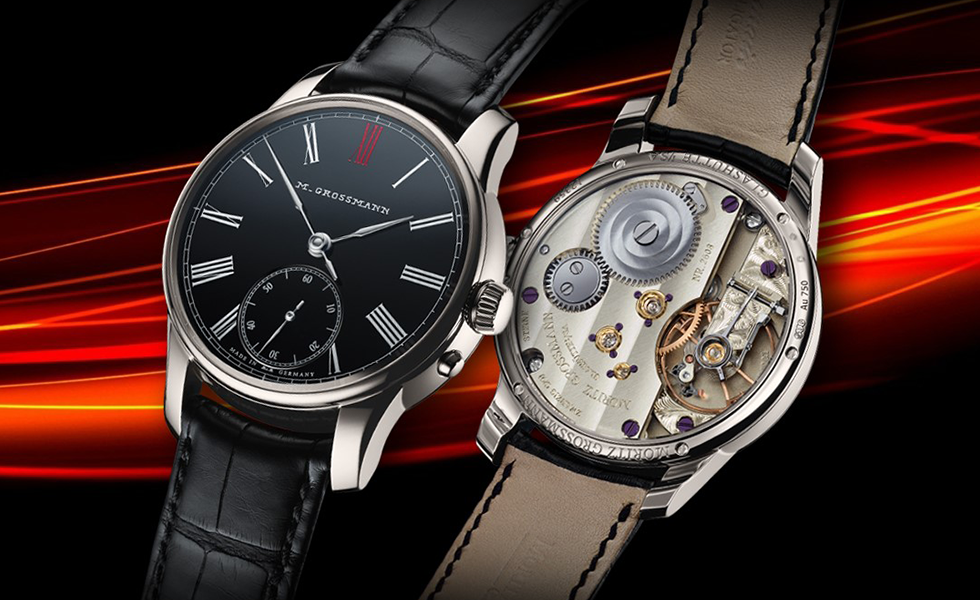
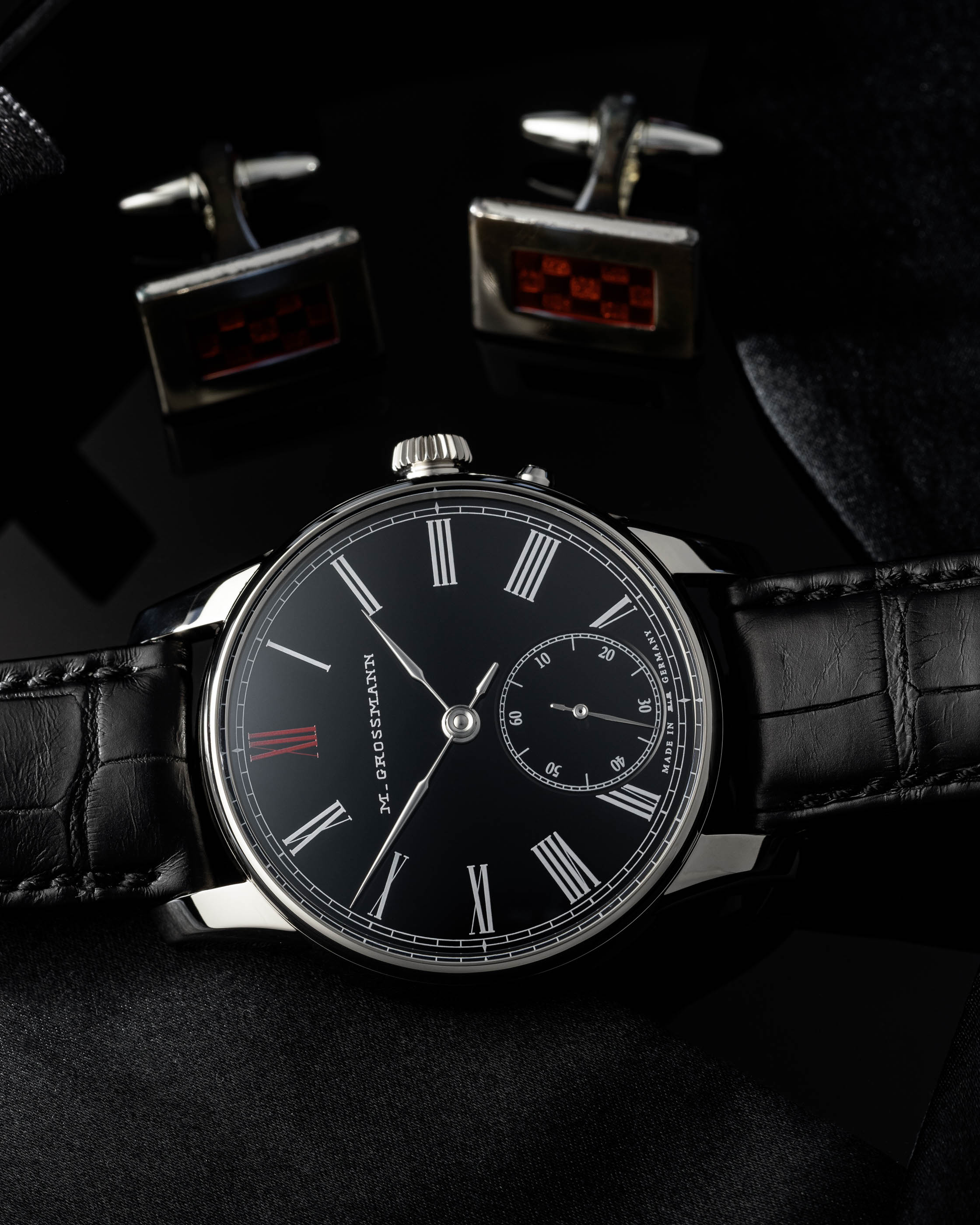
The ENAMEL ROMAN Vintage, which is limited to eight pieces, serves as a contemporary interpretation of the company's philosophy: its theme is the contrast between black, white and red, which brings the art of watchmaking as cultivated by Moritz Grossmann into the modern age.

The deep, perfect shade found on the dial draws the eye. It is rooted in the technique of enamelling, an ancient craft. The oldest known enamels date from the centuries before Christ, when artistic enamels were already being used by people in East Asia and the ancient Egyptians. Later, the art of enamelling experienced a heyday in Byzantium and also in Europe. Even early on, people marvelled at enamel because of its colourfulness, beauty and radiance, and later it was prized for its characteristics, including durability, the fact that it does not age, is smooth and has a fine yet subtle sheen.

As pocket watches started to be made, enamel gained in importance when it came to the production of dials. Its use spread to Saxony, where the art of enamelling was cultivated in gold and silversmithing. In the 17th and 18th centuries, for example, Georg Friedrich Dinglinger, a brother of the well-known Dresden court goldsmith Melchoir Dinglinger, produced some impressive works. Both artists worked under the patronage of Augustus the Strong, Elector of Saxony and King of Poland. Works of art from their workshops can today be admired at the Grünes Gewölbe in Dresden.
 

The art of enamelled dials
With the renaissance of the mechanical watch, the enamel dial has gained admirers once again. It is treasured not only for its beauty, but also because people are now aware of what is involved in its creation, a complex process that requires much skill. Enamel is formed from glass and other additives. The enamel granules are pulverised, with metal oxides or ceramic pigments lending them their colour. The enamel is then sieved while dry or applied to a dial blank as part of a blend of enamel powder, water and glue. Following the first round of firing and cooling, enamel powder is once again applied to the front and it is fired again. This process of firing, applying enamel powder and firing again is repeated several times.

Layer by layer, this creates a uniform, shiny surface that can be printed with numerals or indices following the final firing. The finished dial is impressively durable: there are no time limits on enamel and it can last for a thousand years.
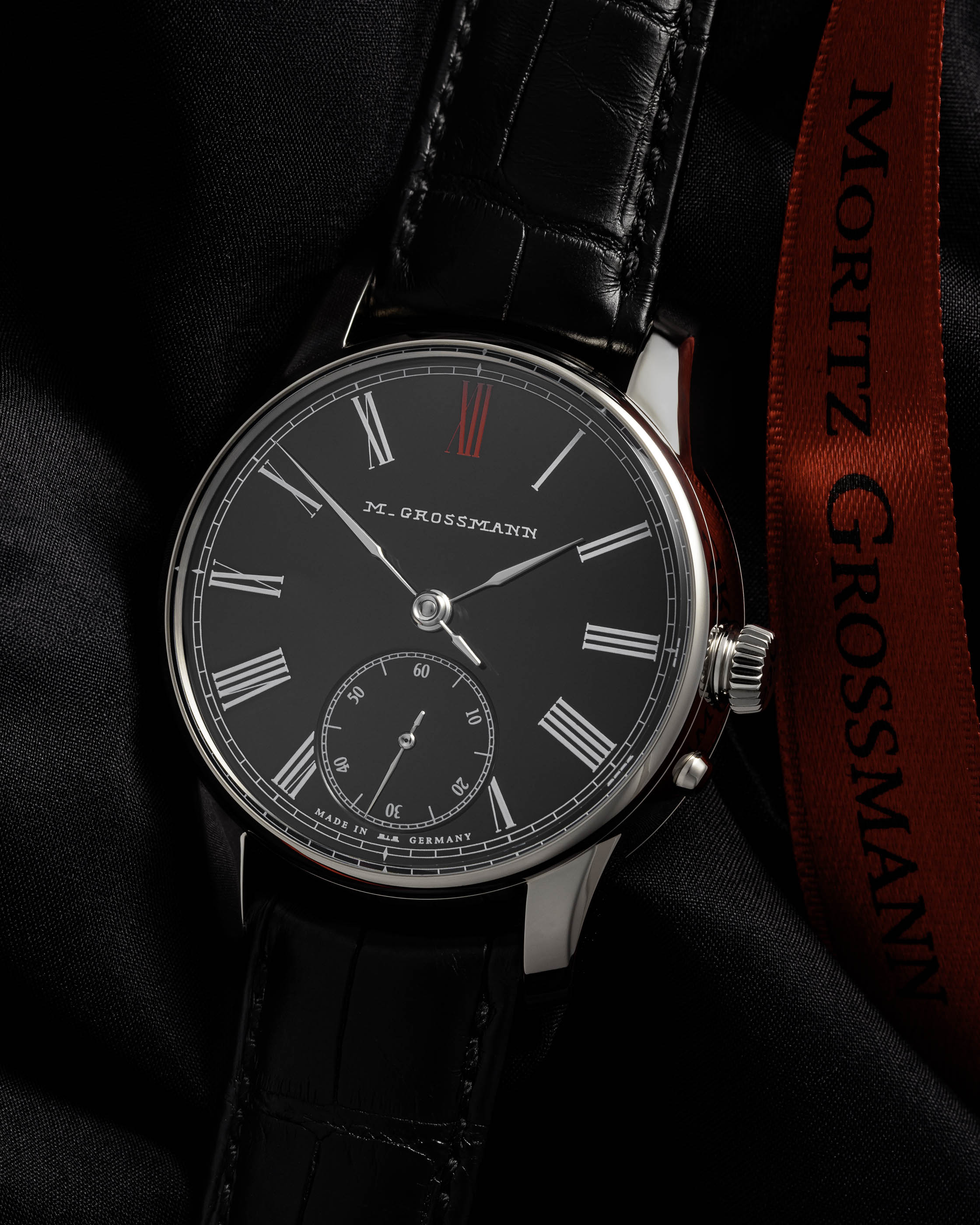
 

Approximately 90 steps are involved in creating a single dial for Moritz Grossmann
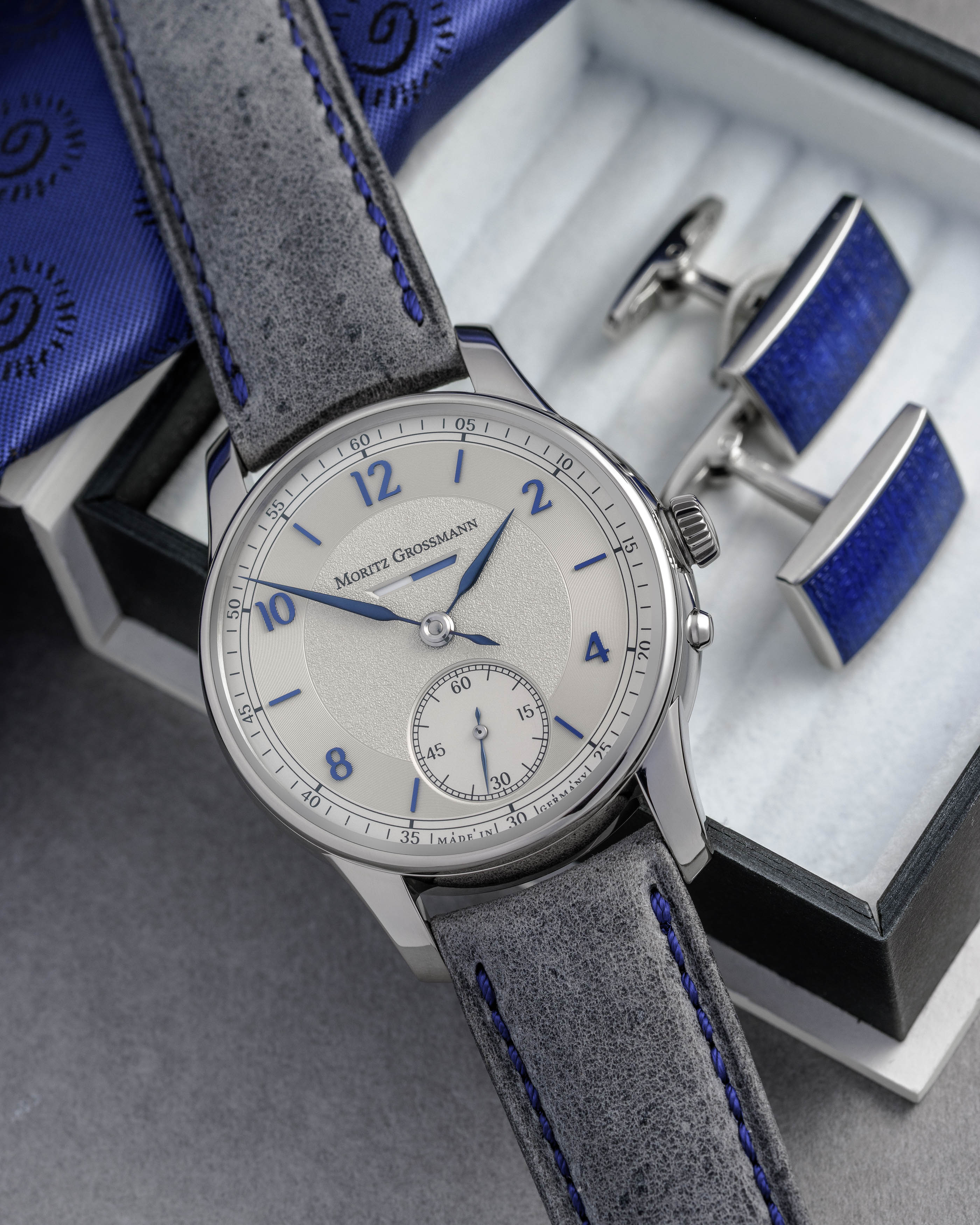
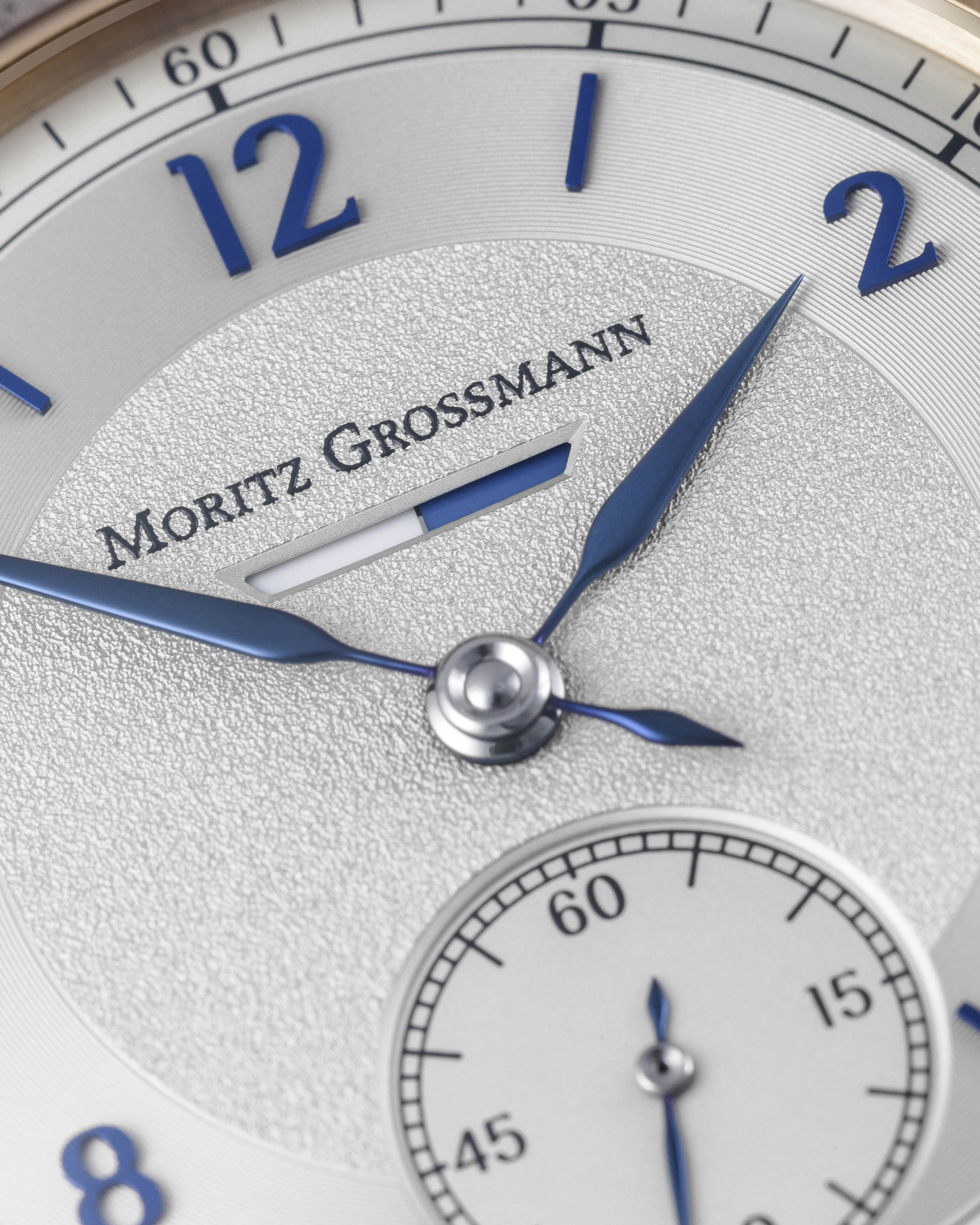
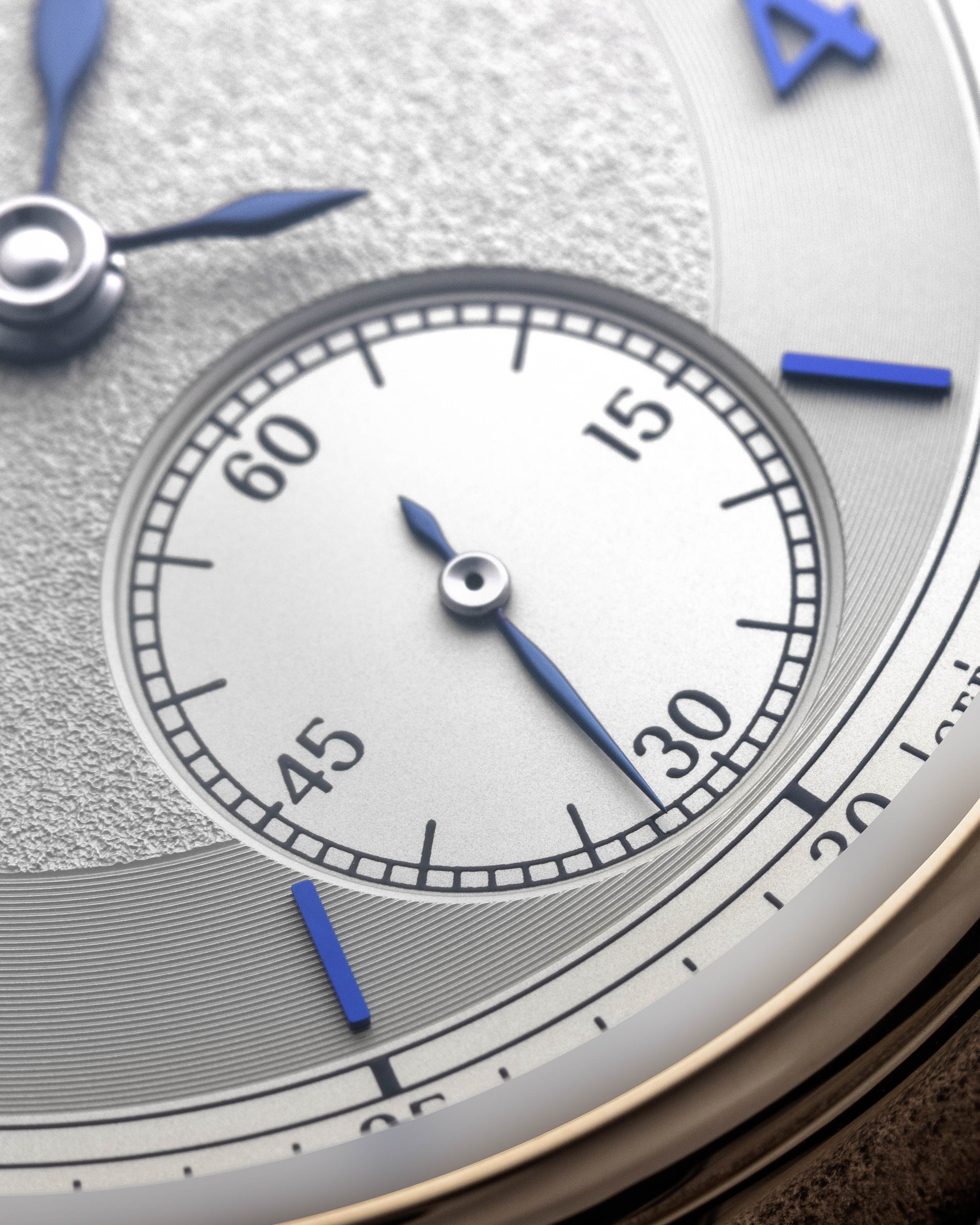
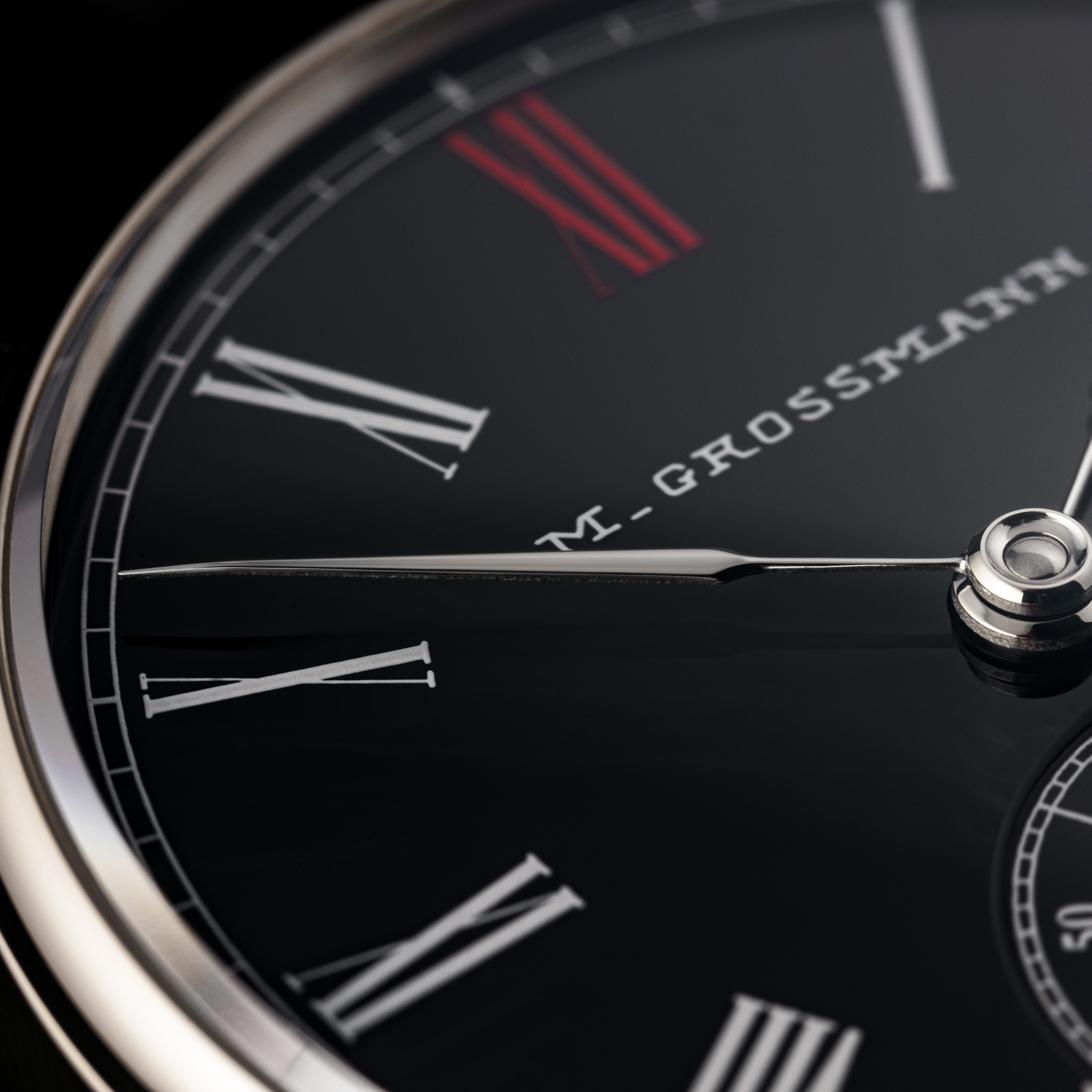
This is the tradition that gave rise to the enamel dial on the ENAMEL ROMAN Vintage by Moritz Grossmann. And this technique was not just used for the colour black, but the numerals, scales and lettering, such as the historic ‘M. Grossmann’ logo, are also made from enamel. These are applied using pad printing and then fired.

In all, around 90 steps are required to complete a single dial. These take several days to complete and at every single stage, there is a risk that the enamel will crack on firing, bubbles will form or the surface will flake. Only a dial that is perfect in every single way will eventually be used in a Moritz Grossmann watch. In such watches, it serves as the canvas for time, above which polished steel hands circle with their finely pointed tips.

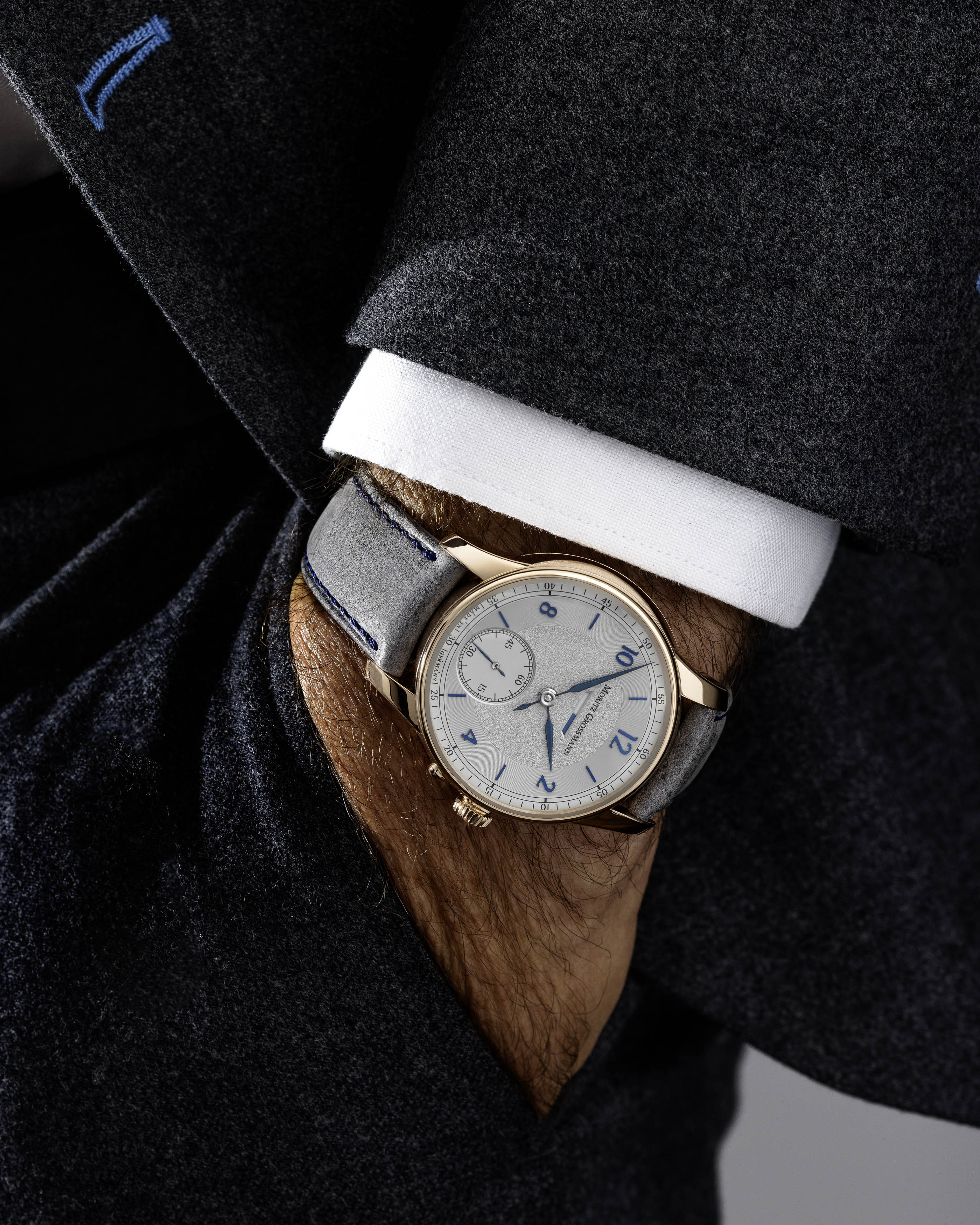
The deep black of the dial is a reminder of the power of colour. The perfectly smooth surface is so still that you feel you could dive straight into it. This effect is underpinned by the slimline, finely drawn Roman numerals that contrast sharply with their clear white and the red XII. A simple case in white gold provides the perfect backdrop, with the sides merging seamlessly into the case horns. The transparent case back offers an unrestricted view of a movement that is perfection itself, matching the finish in every detail.
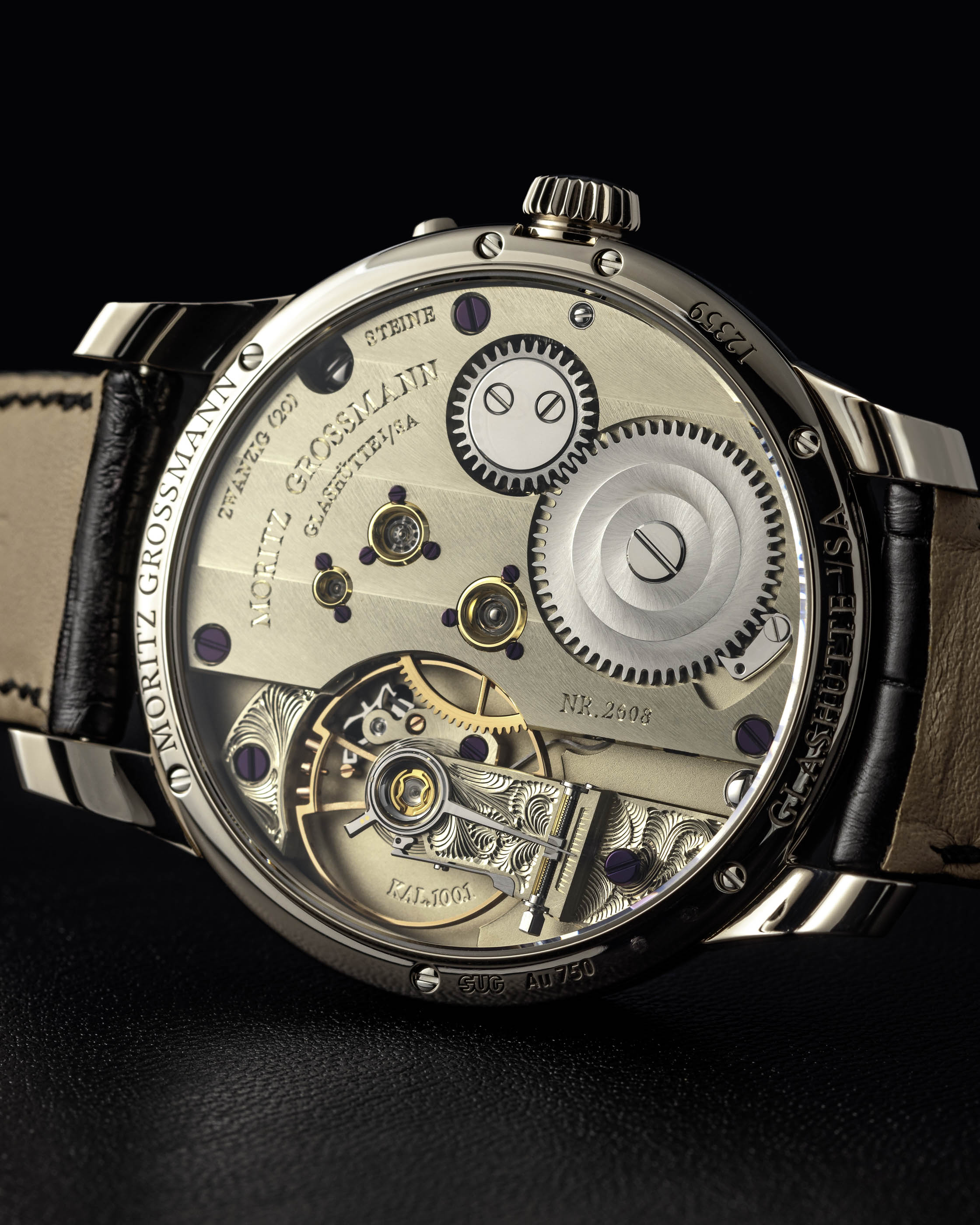
 

The art of watchmaking from Glashütte: the calibre 100.1
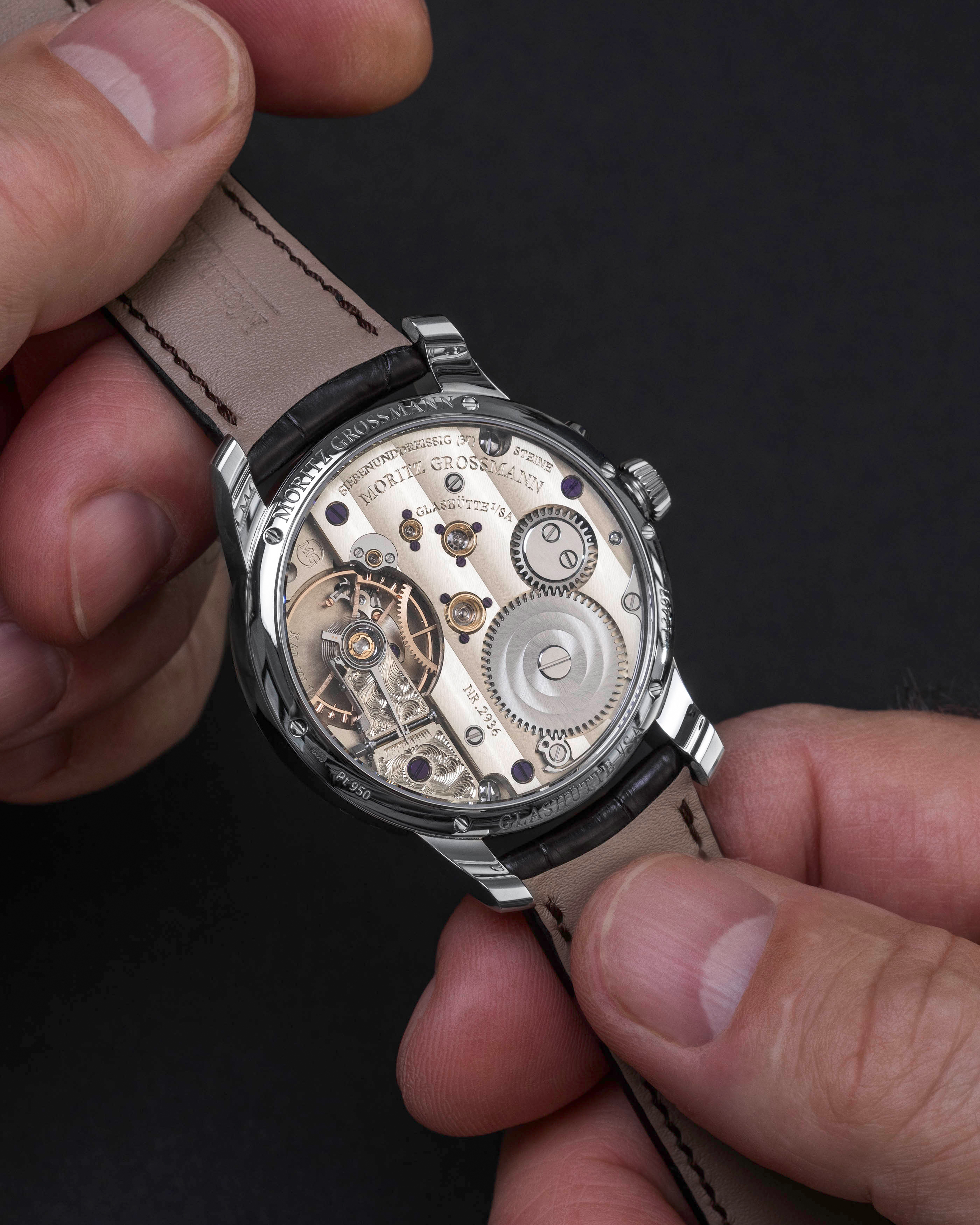
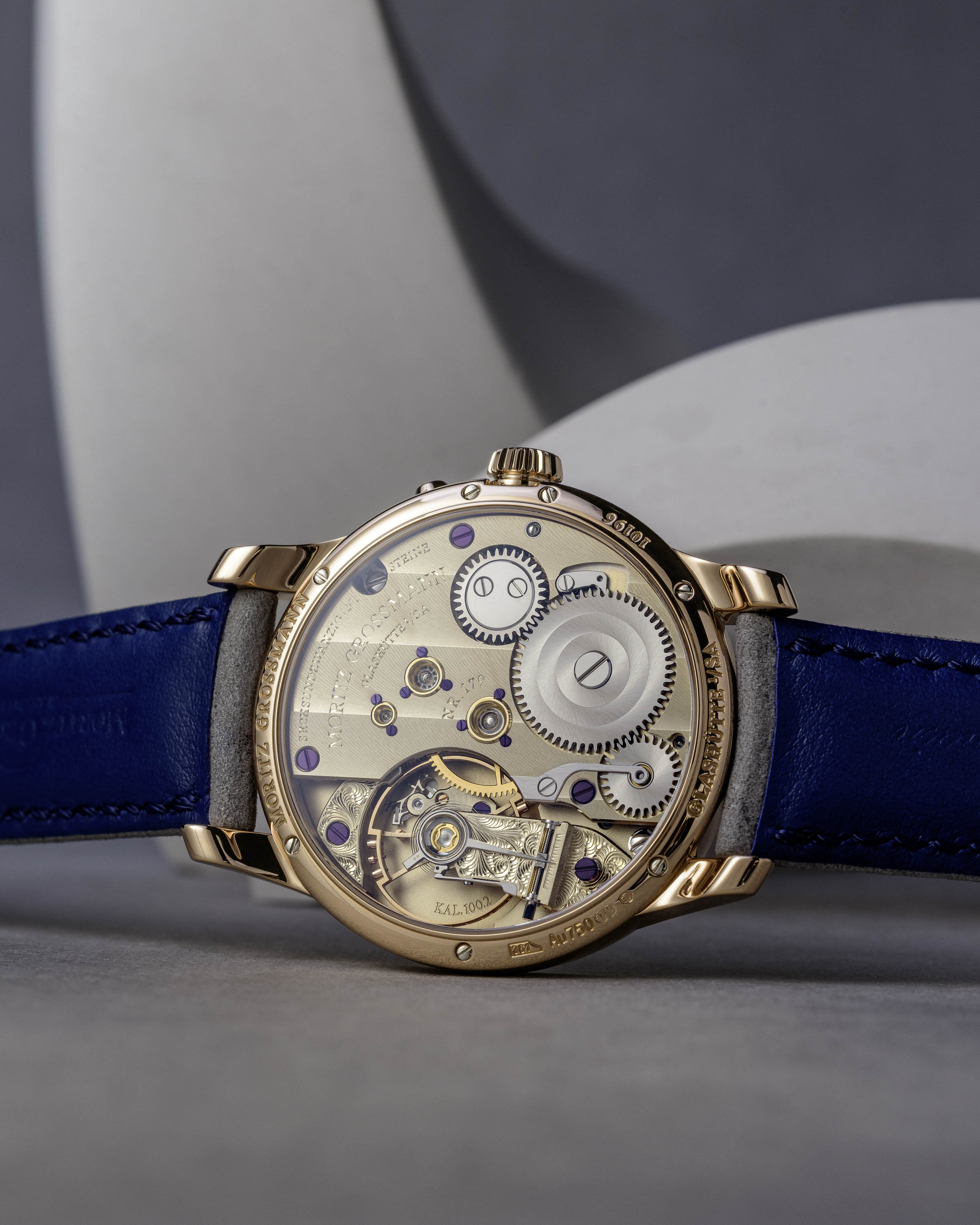
The inside of the ENAMEL ROMAN Vintage is home to the calibre 100.1, a pillar movement with well-proportioned components made from untreated German silver in a high-quality finish. The characteristic 2/3 plate with broad, horizontal ribbing has been signed by a hand engraving. It has a curved cut-out that reveals the distinctive Grossmann balance, held by a stepped, hand-engraved balance cock with the typical fine micrometer screw.

Another special feature of the manufactory movement is the perfected hand setting mechanism, which eliminates two potential problem areas: avoiding the ingress of foreign particles during the adjustment process and altering the hands unintentionally when pushing the crown back into place.

With a short pull on the winding crown, the mechanism switches to hand setting and stops the movement at the same time. The crown immediately returns to its original position, where the hands can now be precisely adjusted. The movement is then restarted using a pusher situated below the winding crown. This simultaneously resets the mechanism to its winding function.
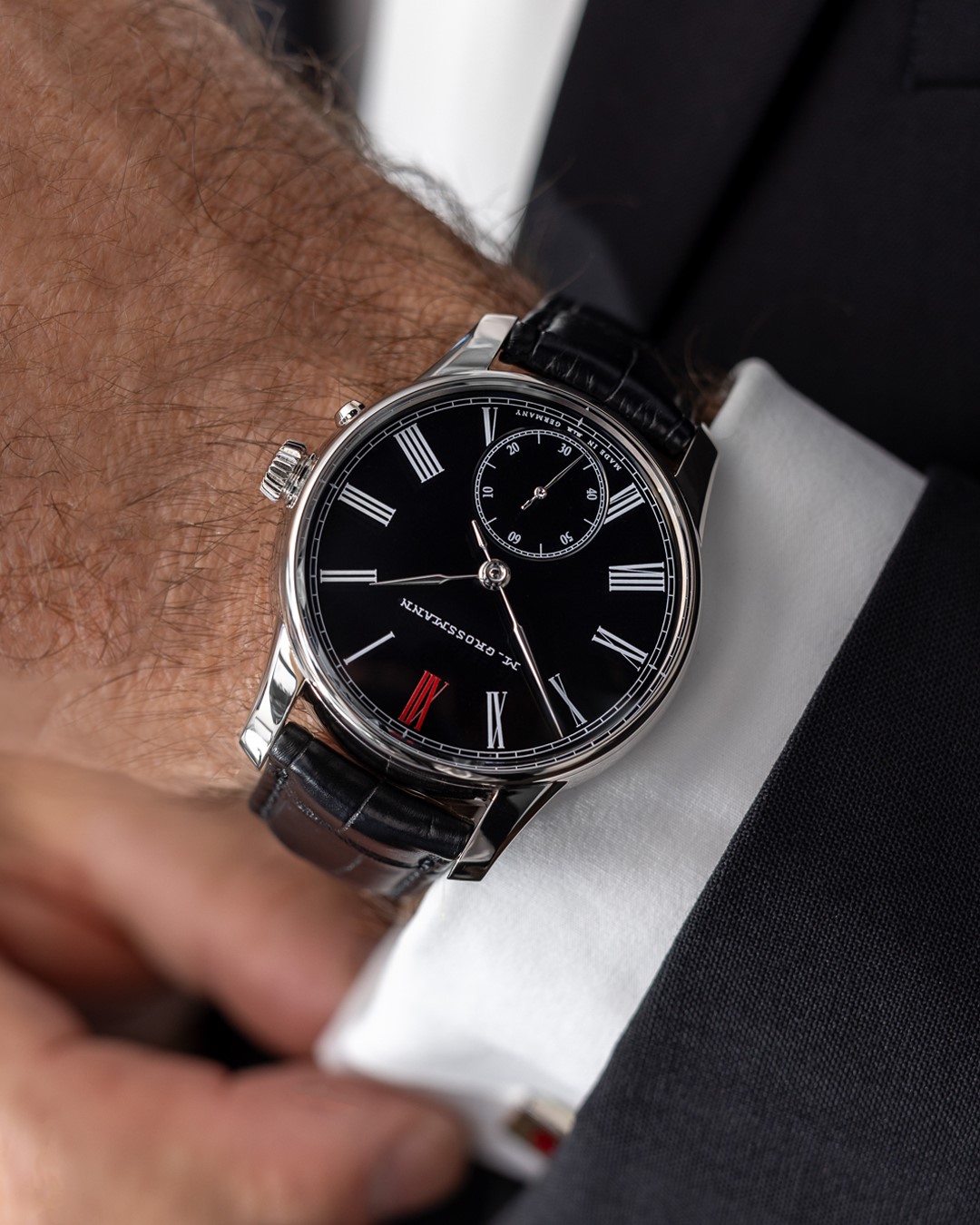
 

Exclusive special edition
The ENAMEL ROMAN Vintage in honour of the 16th anniversary of the manufactory has a case in white gold, worn on a black alligator leather strap. This special model is limited to eight pieces.
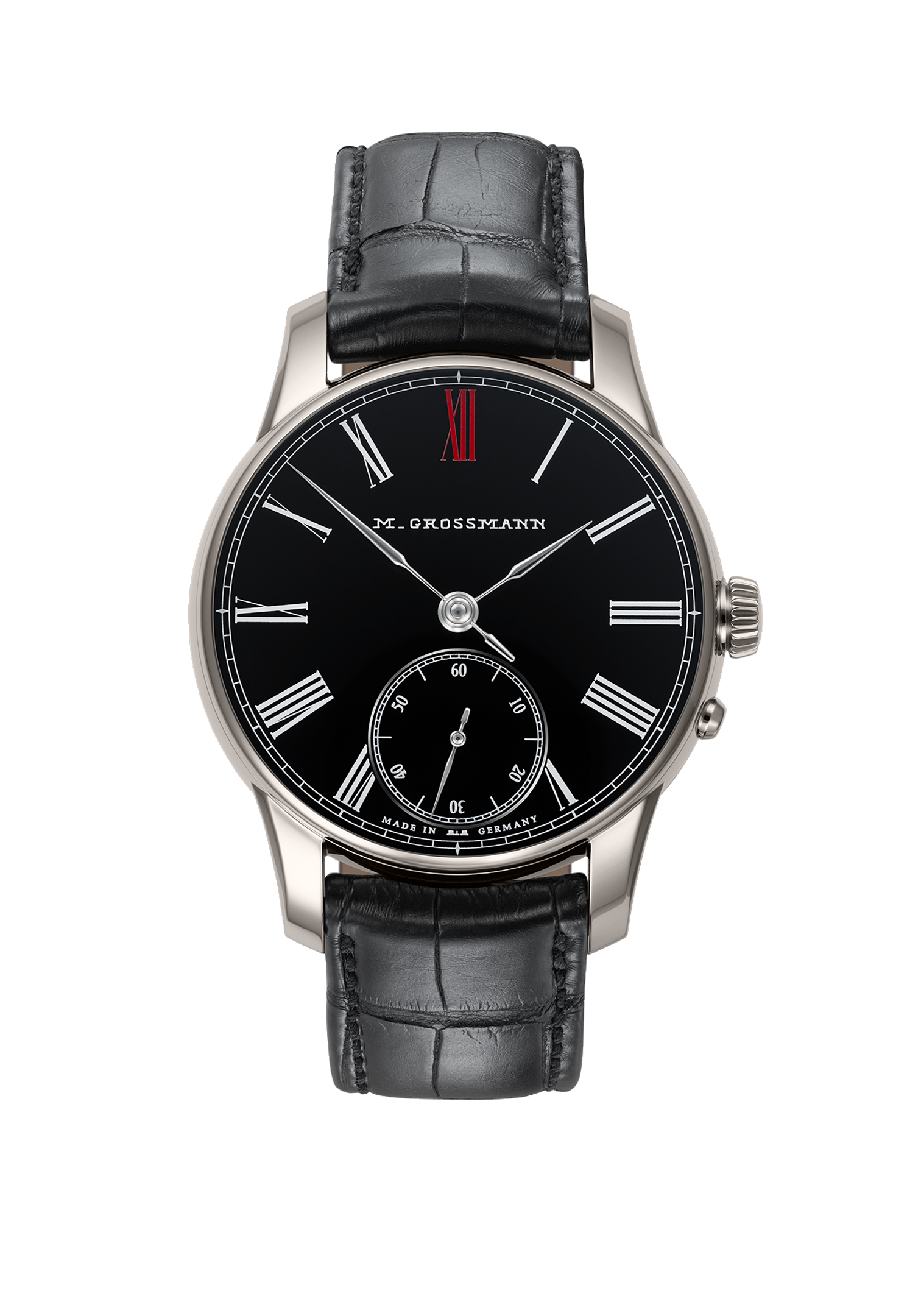
 

Enamel Roman Vintage

Technical Data


Version   Limited Edition of 8 pieces
Reference   MG-003717
     
Movement   Manufactory calibre 100.1, manual winding, regulated in five positions
No. of parts   198
Jewels   20 jewels, of which 3 in screwed gold chatons
Escapement   Lever escapement
Oscillator   Shock-resistant Grossmann balance with 4 inertia screws and 2 poising screws, Nivarox 1 balance spring with No. 80 Breguet terminal curve, Gustav Gerstenberger geometry
Balance Diameter   14.2 mm, frequency 18,000 semi-oscillations per hour
Power reserve   42 hours when fully wound
Functions   Hours and minutes, subsidiary seconds with stop second, Grossmann manual winder with pusher
Special features   Grossmann balance; hand setting override and start of movement with lateral pusher; space-saving modified Glashütte stopwork with backlash; adjustment with Grossmann micrometer screw on cantilevered balance cock; pillar movement with 2/3 plate and pillars made of untreated German silver; hand-engraved 2/3 plate, balance cock and escape-wheel cock hand-engraved; broad horizontal Glashütte ribbing; 3-band snailing on the ratchet wheel; raised gold chatons with pan-head screws; separately removable clutch winding mechanism; stop seconds for hand setting
Operating elements   Crown in 750/000 gold , to wind the watch and set the time, pusher in 750/000 gold to start the movement
Case dimensions   Diameter: 41.0 mm, height: 11.35 mm
Movement dimensions   Diameter: 36.4 mm, height: 5.0 mm
Case   Three-part, precious metal
Dial   Enamel, Roman numerals in white, XII in red
Hands   Manually crafted, polished steel
Crystal/display back   Sapphire crystal, antireflective coating on one side
Strap   Hand-stitched alligator leather with prong buckle in precious metal


Related Articles

JULY 16 2025    |    Novelties

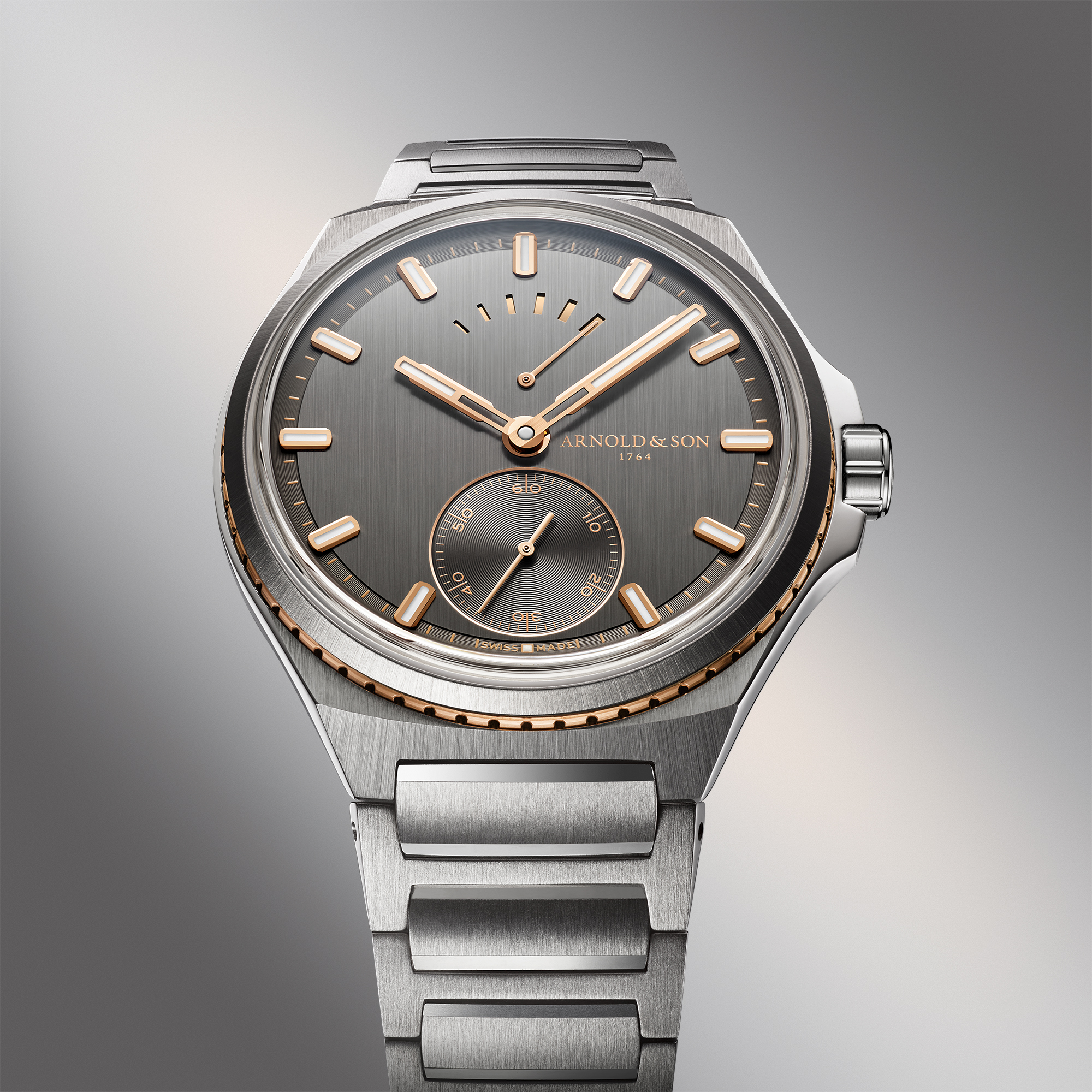
Longitude Titanium 5°W: Precision and Elegance Inspired by the Seas

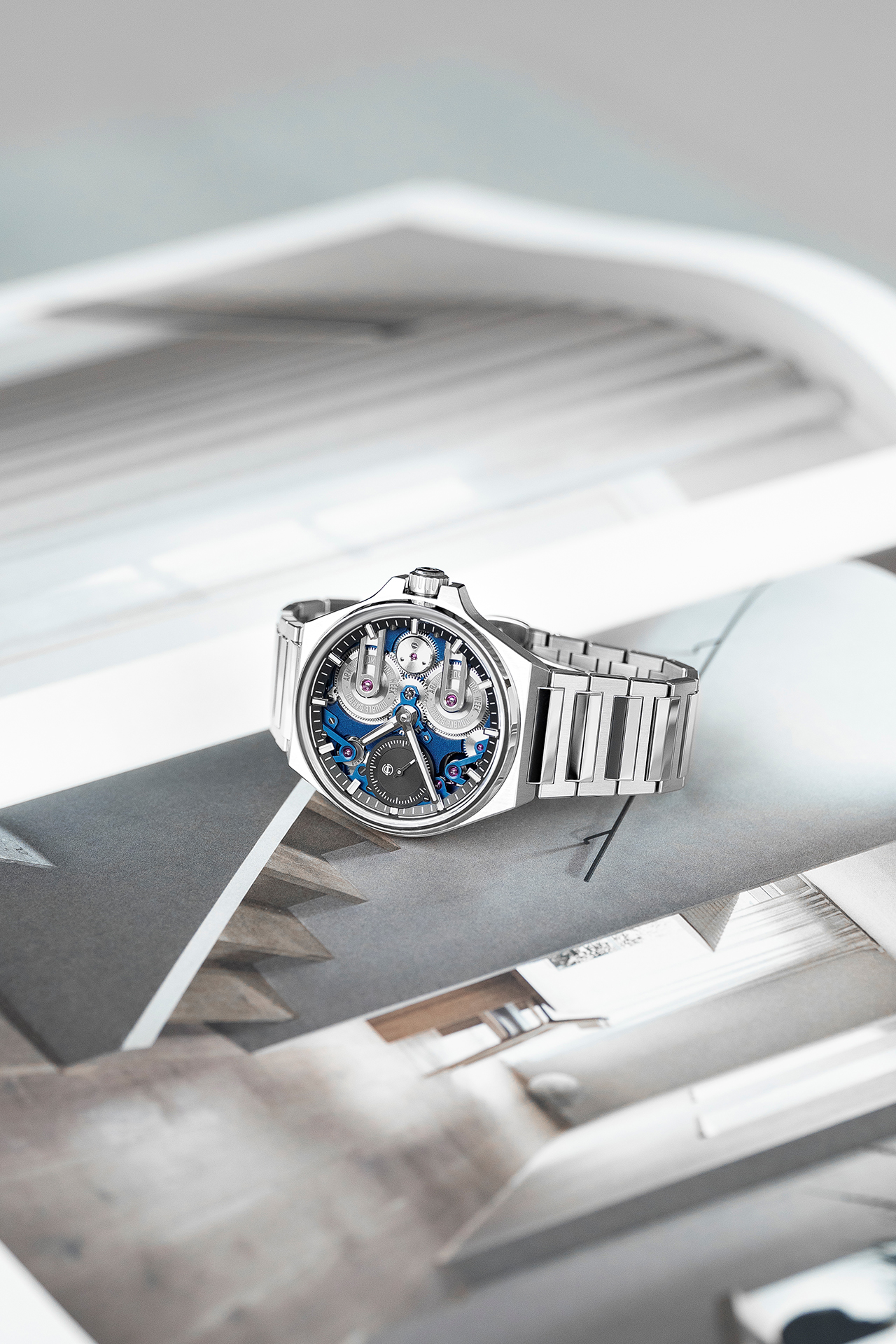
Arnold & Son proudly presents the Longitude Titanium 5°W Edition, a timepiece inspired by the marine chronometers crafted by John Arnold in the late 18th century. These instruments revolutionized navigation and played a pivotal role in the British Navy’s mastery of the seas.

This limited edition of 38 pieces combines grade 5 titanium with an 18K red gold bezel ring, echoing the elegance of historical chronometers. The Lizard Point Grey dial, with its vertical satin finish, evokes the stormy hues of the North Atlantic near Lizard Point—the southernmost tip of mainland Great Britain at 5° west longitude.

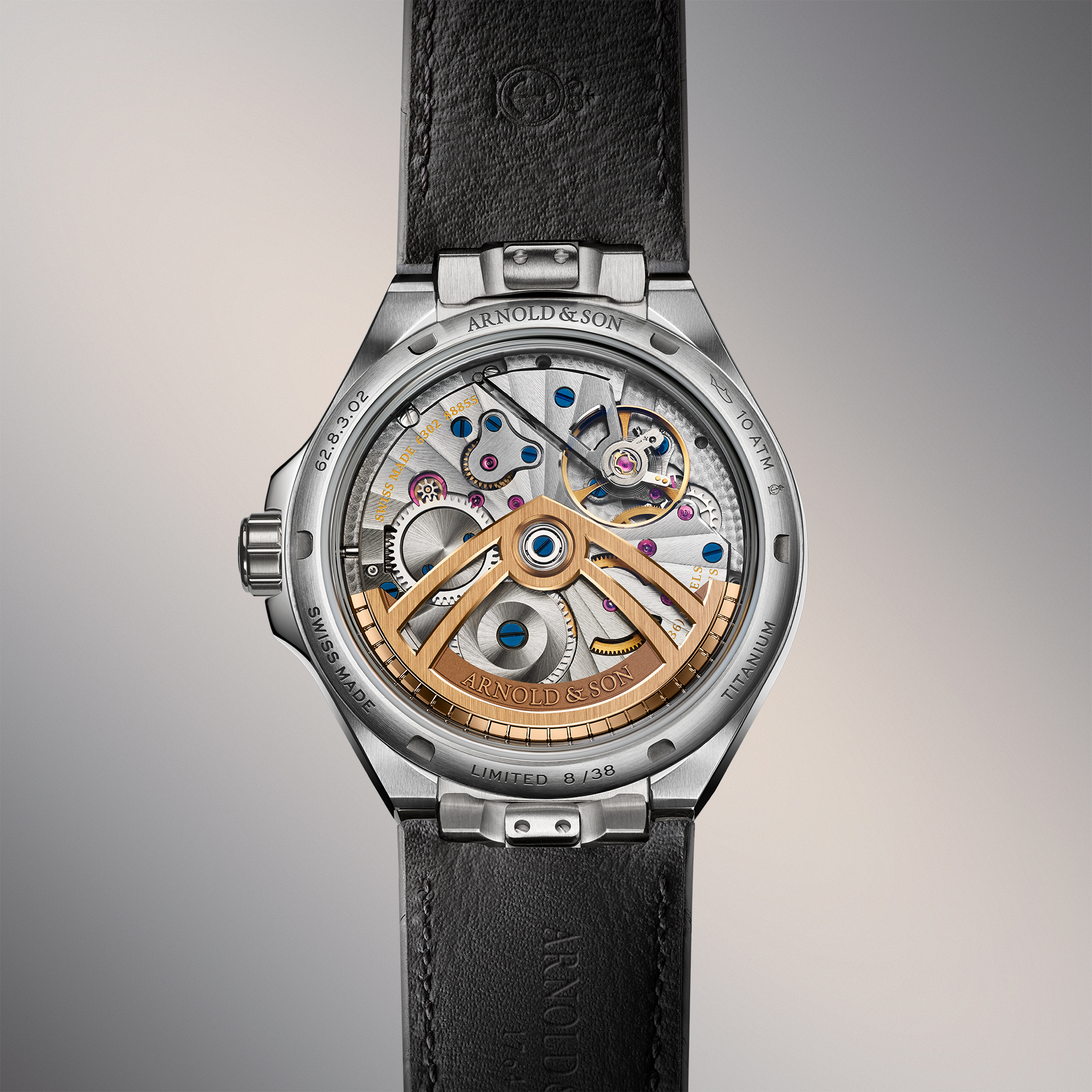
Inside beats the A&S6302 calibre, an in-house automatic movement certified by the COSC as a chronometer. It offers a 60-hour power reserve, a power-reserve indicator at 12 o’clock, and a small seconds subdial opposite. Through the sapphire case back, the palladium-plated bridges and skeletonized 22K red gold oscillating weight—engraved with a ship and sextant motif—reveal the artistry of Arnold & Son.

Water-resistant to 100 meters, the Longitude Titanium 5°W features an interchangeable strap system, allowing effortless transition between an anthracite grey alligator leather strap and a titanium bracelet.

View Watch Gallery
Image 1 Image 2
View More
APRIL 01 2025    |    Novelties

A Star Fragment, Guardian of Time: The Grand Planetarium Eccentric Meteorite

Time and space converge in the latest masterpiece of haute horlogerie: the Grand Planetarium Eccentric Meteorite. This extraordinary timepiece is crafted from a genuine meteorite fragment—once part of an asteroid’s core, drifting through space for billions of years before falling to Earth 50,000 years ago. Now, this celestial relic has been transformed into an exceptional watch, uniting cosmic heritage with unparalleled horological innovation.

At the heart of this timepiece lies a groundbreaking complication: the Eccentric Planetarium, the only mechanical Grand Planetary Complication in the world that accurately displays all eight planets—Mercury, Venus, Earth and her Moon, Mars, Jupiter, Saturn, Uranus, and Neptune—moving in real time around the Sun. This breathtaking mechanism captures the celestial dance of our Solar System with unmatched precision, making it a true marvel of both astronomy and watchmaking.

A Celestial Fusion of Science and Art
Master watchmaker Pim Koeslag has meticulously sculpted this timepiece, ensuring that its construction reflects the grandeur of its cosmic origins. The meteorite case, weighing 47 grams, is carefully crafted out of a 1.09 kg space stone. This extraordinary material shaped by the universe itself, features a unique Widmanstätten pattern, formed over millions of years of slow cooling in space, making each case truly one of a kind.

The dial is a celestial spectacle in itself: crafted from aventurine glass (goldfluss), it mimics the night sky, complete with zodiac constellations. The Eccentric Planetarium features hand-painted planetary orbits, while the meteorite dial ring, set between Mars and Jupiter, signifies the asteroid belt and contains real fragments of a martian nakhlite meteorite —a piece of another world encased within this exceptional timepiece.


A Timepiece Beyond Time
Encased in domed sapphire crystal, the 44mm meteorite case showcases the celestial ballet within. The sapphire crystal case-back reveals the movement’s intricate craftsmanship, while the dark blue hand-stitched leather strap and platinum folding clasp complete this cosmic masterpiece.

“The Grand Planetarium Eccentric Meteorite is more than a watch. It is a link between humanity and the cosmos, a way to wear the universe on your wrist,” says Pim Koeslag.

This timepiece is a tribute to time itself. From a star’s death to an asteroid’s journey, from its fall to Earth to its transformation into an exceptional watch—each second it measures is an echo of the vast cosmic history it carries.

An Exclusive, Limited Edition for Collectors
The Grand Planetarium Eccentric Meteorite is available in a strictly limited edition, with a maximum of 3 pieces, depending on the avaibility and quality of the rough meteorite material. So far, Christiaan van der Klaauw has been able to produce only 2 pieces from the available material, making this timepiece an exceptionally rare collector’s item. This extraordinary creation offers the unique opportunity to own a fragment of a star, forever marking the passage of time.

About Christiaan van der Klaauw
Christiaan van der Klaauw is one of the most prestigious watchmaking houses in the Netherlands, specializing in astronomical watches. Founded in 1974, the brand has distinguished itself by its ability to integrate astronomical complications innovatively and artistically into high-precision timepieces. The Grand Planetarium eccentric model is one of its most iconic Grande Complication, representing the quintessence of art and science.

View More
MARCH 24 2025    |    Watches and Wonders 2025

Constant Force Tourbillon 11, yellow gold edition - A celebration of watchmaking ingenuity

The 41.5 mm diameter Constant Force Tourbillon 11 watch in 18-carat yellow gold, released by Arnold & Son as a limited edition of 11, is driven by a hand-wound mechanical movement. Equipped with two barrels to give a 100-hour power reserve, this timepiece was entirely developed and built at the manufacture in La Chaux-de-Fonds. It is fitted with a constant force mechanism visible on the enamel dial and is regulated by a tourbillon that can be seen on the back. The architecture of this calibre is inspired by that of the timekeeping instrument driven by the first tourbillon created by Abraham-Louis Breguet in 1808, based on a chronometer movement designed by John Arnold. This first tourbillon regulator, now in the British Museum, was given to John Roger Arnold by the Paris-based watchmaker in honour of his scientific collaboration and friendship with his father. The Constant Force Tourbillon 11 timepiece, designed to mark the end of the 260th anniversary celebrations of John Arnold’s legacy, pays tribute to the watchmaker’s ingenuity and his close association with Abraham-Louis Breguet.

The greatest watchmakers of the Age of Enlightenment often knew each other. Some of them exchanged views and appreciated each other despite language barriers and political obstacles. And this was the case with John Arnold and Abraham-Louis Breguet. These two watchmakers, undoubtedly the most productive of the second half of the 18th century, forged a friendship that nothing could shake, not even the throes of war between the two countries or the French Revolution. Aware of their respective talents, during Abraham-Louis Breguet’s frequent trips to London between 1789 and 1791, they shared their views and knowledge of the principles of timekeeping, furthering the science of timekeeping, which in their eyes definitely knew no frontiers.

View More
AUGUST 19 2025    |    Novelties

Chronoswiss Celebrates 30 Years of Horological Innovation with the Opus Purple Rain Limited Edition

Chronoswiss celebrates three decades of horological mastery with the launch of the Opus Purple Rain, a bold and limited edition chronograph that reimagines the brand’s iconic skeletonized timepiece. Limited to just 30 pieces worldwide, this anniversary edition marks a milestone in modern independent watchmaking, honoring the legacy of the original Opus while pushing the boundaries of design and mechanical transparency.

First introduced in 1995 by Chronoswiss founder Gerd-Rüdiger Lang, the Opus revolutionized the chronograph landscape by exposing its intricate movement architecture on the dial side—a radical departure from the traditionally closed and utilitarian chronographs of the time. The Opus became a symbol of mechanical artistry and a signature of the brand’s avant-garde spirit.

The Opus Purple Rain carries this legacy into the future with unapologetic flair. Encased in Grade 5 titanium and finished with a radiant purple CVD coating, the watch is both lightweight and visually arresting. Its skeletonized dial, also rendered in ultraviolet hues, reveals the ruthenium-coated Chronoswiss C.741S automatic chronograph caliber, offering a 46-hour power reserve and a full suite of chronograph functions including central seconds, 30-minute and 12-hour counters, small seconds, and date.

Adding to its rebellious character is a white UV-reactive leather strap that transforms into glowing purple when exposed to sunlight—an unexpected and surreal tribute to the energy behind this creation. Signature Chronoswiss elements such as the onion crown, coin-edged bezel, and patented Autobloc screw-in lugs remain intact, anchoring the watch in its heritage while embracing a futuristic aesthetic.

“The Opus Purple Rain is not just a commemorative piece—it’s a statement,” said Chronoswiss CEO Oliver Ebstein. “It embodies the spirit of mechanical transparency and innovation that has defined Chronoswiss for 30 years. This is a watch for those who dare to see how far precision and design can be pushed.”

With only 30 pieces produced, the Opus Purple Rain is destined to become a collector’s treasure—a celebration of the past, a vision of the future, and a mechanical theatre on the wrist. 

View Watch Gallery  
Image 1  Image 2  Image 3  Image 4
View More
OCTOBER 17 2025    |    Novelties

Armin Strom Unveils Mirrored Force Resonance Zeitgeist 1665 – A Tribute to Horological History

Armin Strom unveils the Mirrored Force Resonance Zeitgeist 1665, a creative interpretation of what a Resonance wristwatch might have looked like centuries ago. This timepiece combines historical horology with modern innovation, celebrating the brand’s milestone achievement of stable and resilient Resonance.

The Zeitgeist features a stainless steel case measuring 43 mm in diameter, paired with an 18K white gold dial in an off-center design. Inside beats the Armin Strom Manufacture Caliber ARF21_ZG, a manual-winding movement with twin-seconds and flyback functionality, offering an impressive 80-hour power reserve. Limited to just 25 pieces worldwide, this exceptional creation pays tribute to the centuries-long pursuit of chronometric consistency, a challenge first explored by Christiaan Huygens in 1665. Armin Strom solved the Resonance Fragility Problem in 2016, making this phenomenon practical for wristwatches.


View Watch Gallery
Image 1   
View More
ENDLESS DISCOVERY IN YOUR INBOX
Join our mailing list to receive insider updates on our latest collections, invites to private events, and other personalized offerings.