Shopping Cart

To mark the 16th anniversary of the manufactory, Moritz Grossmann presents the limited-edition ENAMEL ROMAN Vintage

NOVEMBER 13 2024    |    Novelties

Black is the absence of light. This is the physical definition of a colour that is synonymous with classicism and elegance. At Moritz Grossmann, black is used to form stylish contrasts and also serves as a testament to the highest standards of craftsmanship. The limited-edition ENAMEL ROMAN Vintage, for example, has an enamel dial whose manufacture presents multiple challenges. With this, Moritz Grossmann has chosen the occasion of its 16th birthday to once again shine the spotlight on the expertise of the ateliers and workshops in Glashütte.

Tradition requires renewal, otherwise it remains stagnant in the past and cannot survive. This is an approach that Moritz Grossmann has embodied since 2008: the manufactory opened 16 years ago as a tribute to one of the most exceptional personalities in the history of watchmaking in Glashütte. Moritz Grossmann was an innovative watchmaker and, with the founding of the German Watchmaking School in Glashütte, influenced a generation of artisans.

His values and vision now live on in the Moritz Grossmann manufactory, which crafts a small but exquisite collection of sophisticated watches that always remain true to the standards of the man who gave the manufactory its name. Characteristics of these timepieces include exclusive manufactory movements with innovative details that are designed, made and finely decorated in-house in the company’s own workshops. The highest of standards also come into play when finishing the watches, as impressively demonstrated by the special model marking the 16th anniversary of the manufactory.
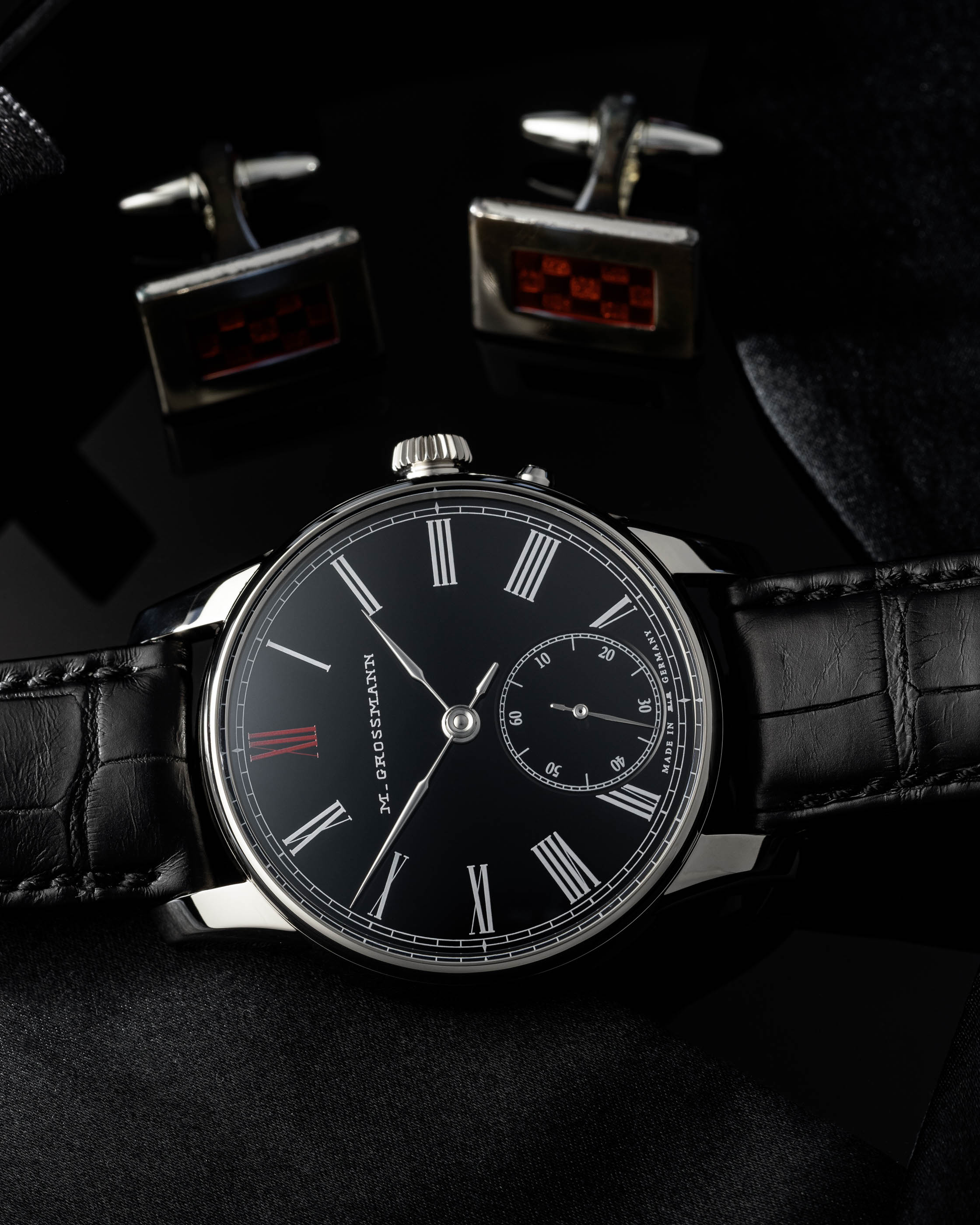
 

ENAMEL ROMAN Vintage: contemporary craftsmanship honouring the 16th anniversary of the manufactory
The ENAMEL ROMAN Vintage, which is limited to eight pieces, serves as a contemporary interpretation of the company's philosophy: its theme is the contrast between black, white and red, which brings the art of watchmaking as cultivated by Moritz Grossmann into the modern age.

The deep, perfect shade found on the dial draws the eye. It is rooted in the technique of enamelling, an ancient craft. The oldest known enamels date from the centuries before Christ, when artistic enamels were already being used by people in East Asia and the ancient Egyptians. Later, the art of enamelling experienced a heyday in Byzantium and also in Europe. Even early on, people marvelled at enamel because of its colourfulness, beauty and radiance, and later it was prized for its characteristics, including durability, the fact that it does not age, is smooth and has a fine yet subtle sheen.

As pocket watches started to be made, enamel gained in importance when it came to the production of dials. Its use spread to Saxony, where the art of enamelling was cultivated in gold and silversmithing. In the 17th and 18th centuries, for example, Georg Friedrich Dinglinger, a brother of the well-known Dresden court goldsmith Melchoir Dinglinger, produced some impressive works. Both artists worked under the patronage of Augustus the Strong, Elector of Saxony and King of Poland. Works of art from their workshops can today be admired at the Grünes Gewölbe in Dresden.
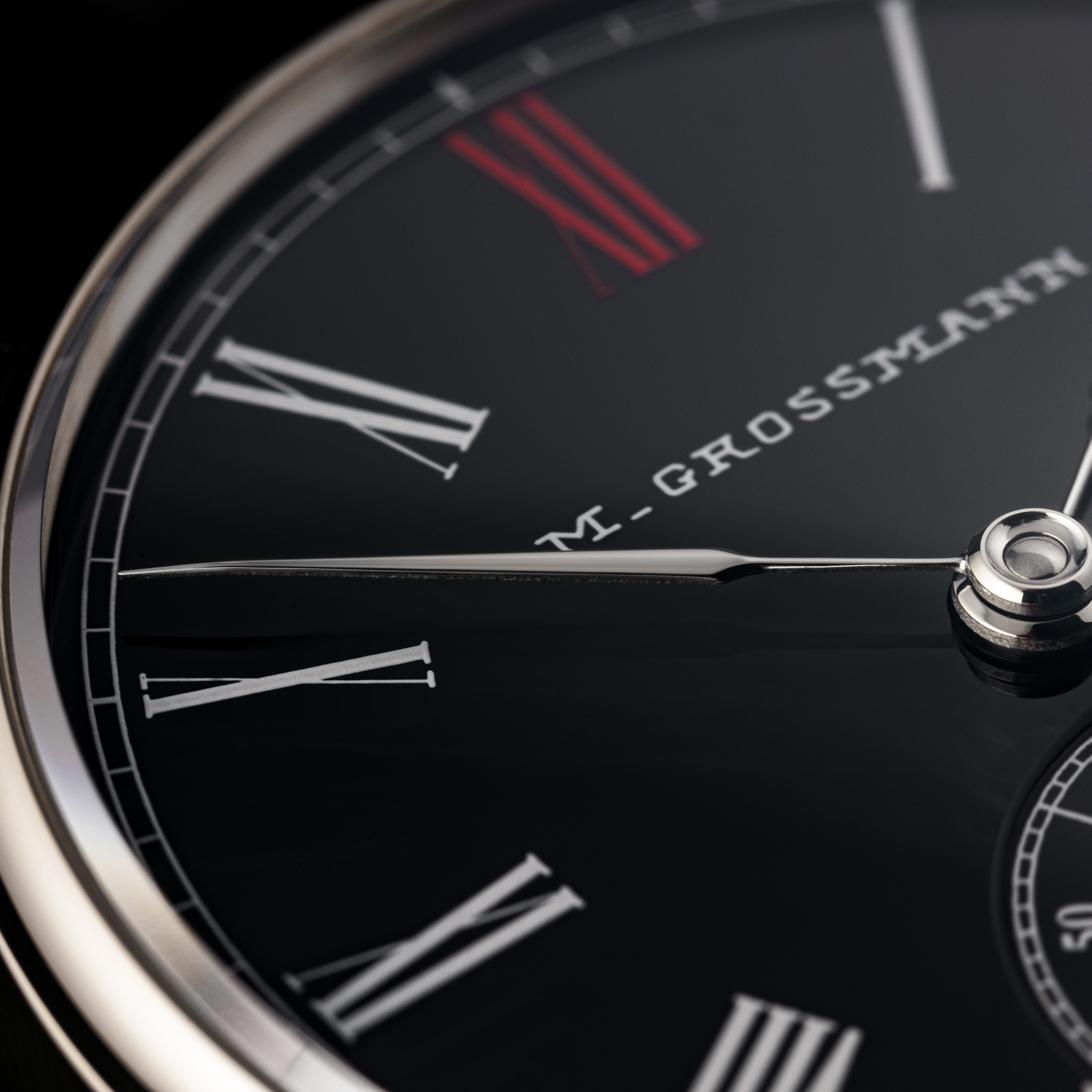
 

The art of enamelled dials
With the renaissance of the mechanical watch, the enamel dial has gained admirers once again. It is treasured not only for its beauty, but also because people are now aware of what is involved in its creation, a complex process that requires much skill. Enamel is formed from glass and other additives. The enamel granules are pulverised, with metal oxides or ceramic pigments lending them their colour. The enamel is then sieved while dry or applied to a dial blank as part of a blend of enamel powder, water and glue. Following the first round of firing and cooling, enamel powder is once again applied to the front and it is fired again. This process of firing, applying enamel powder and firing again is repeated several times.

Layer by layer, this creates a uniform, shiny surface that can be printed with numerals or indices following the final firing. The finished dial is impressively durable: there are no time limits on enamel and it can last for a thousand years.
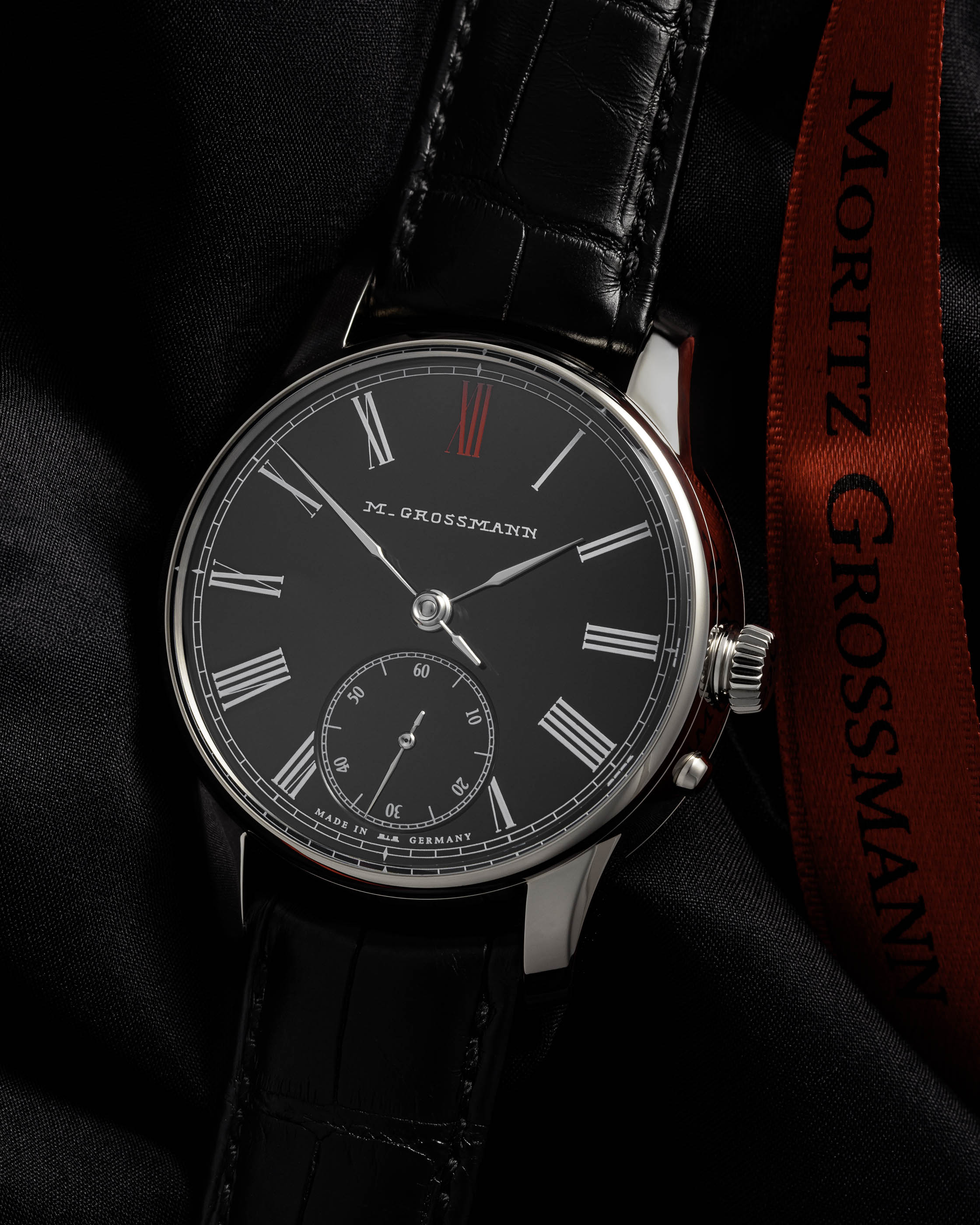
 

Approximately 90 steps are involved in creating a single dial for Moritz Grossmann
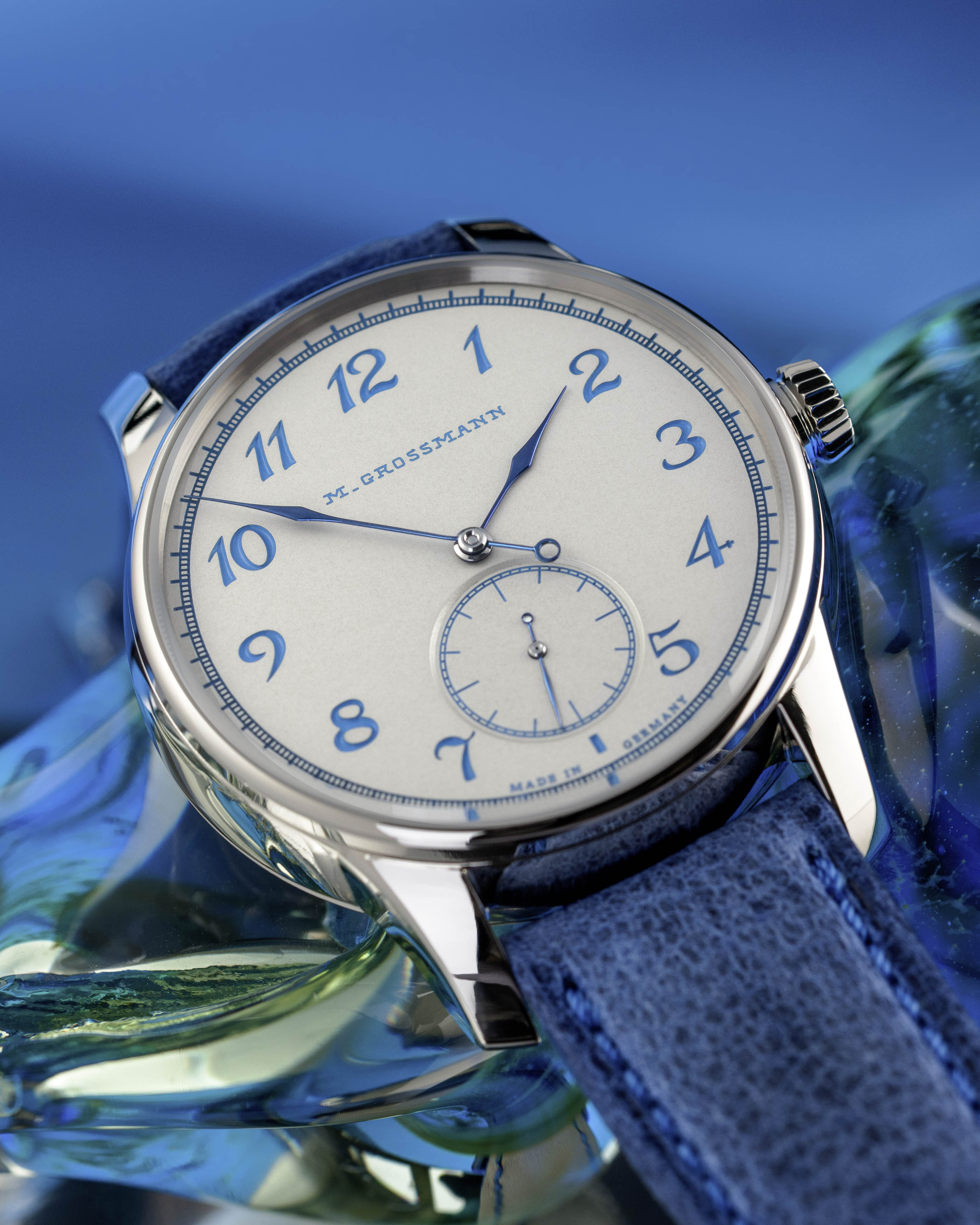
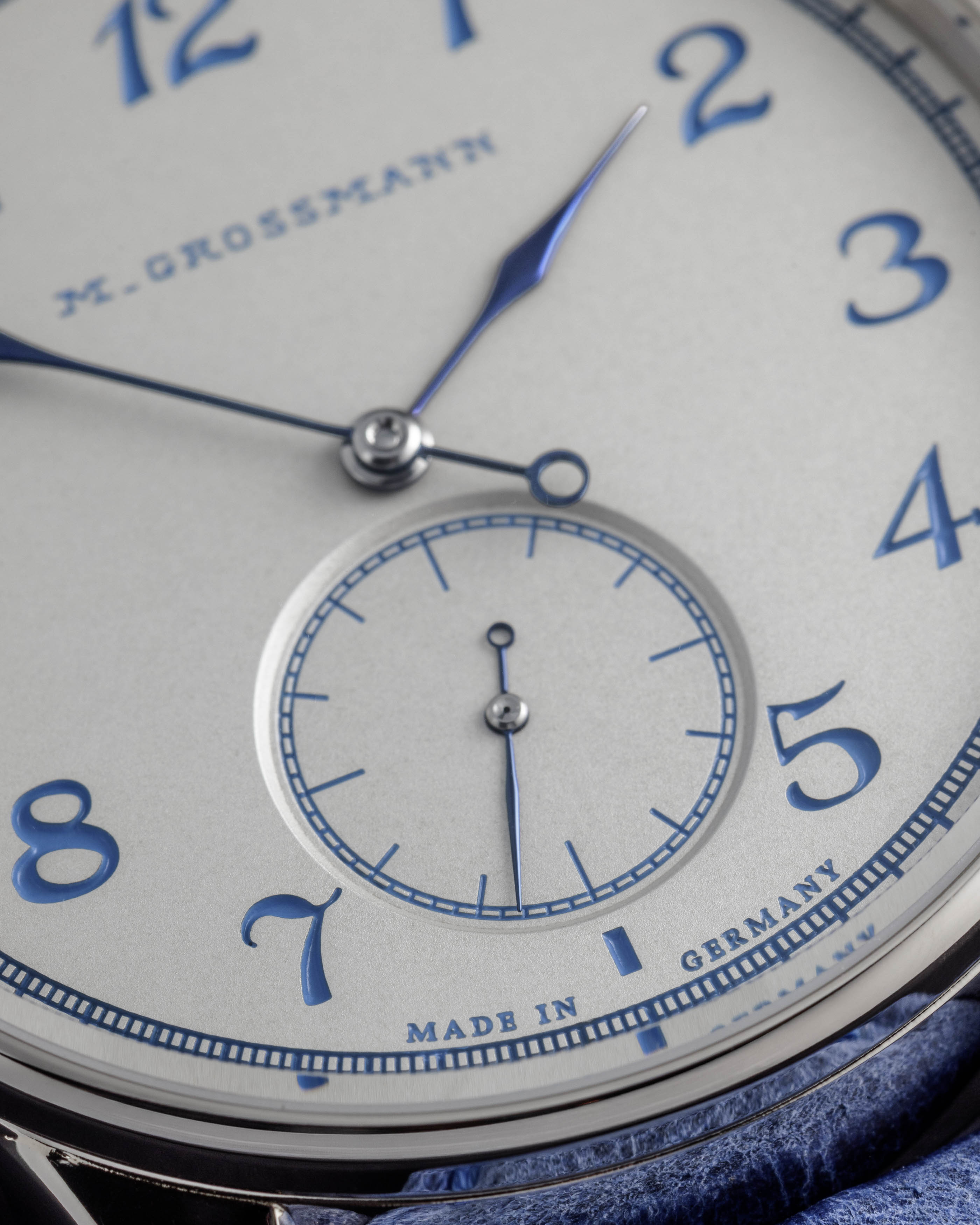
This is the tradition that gave rise to the enamel dial on the ENAMEL ROMAN Vintage by Moritz Grossmann. And this technique was not just used for the colour black, but the numerals, scales and lettering, such as the historic ‘M. Grossmann’ logo, are also made from enamel. These are applied using pad printing and then fired.

In all, around 90 steps are required to complete a single dial. These take several days to complete and at every single stage, there is a risk that the enamel will crack on firing, bubbles will form or the surface will flake. Only a dial that is perfect in every single way will eventually be used in a Moritz Grossmann watch. In such watches, it serves as the canvas for time, above which polished steel hands circle with their finely pointed tips.

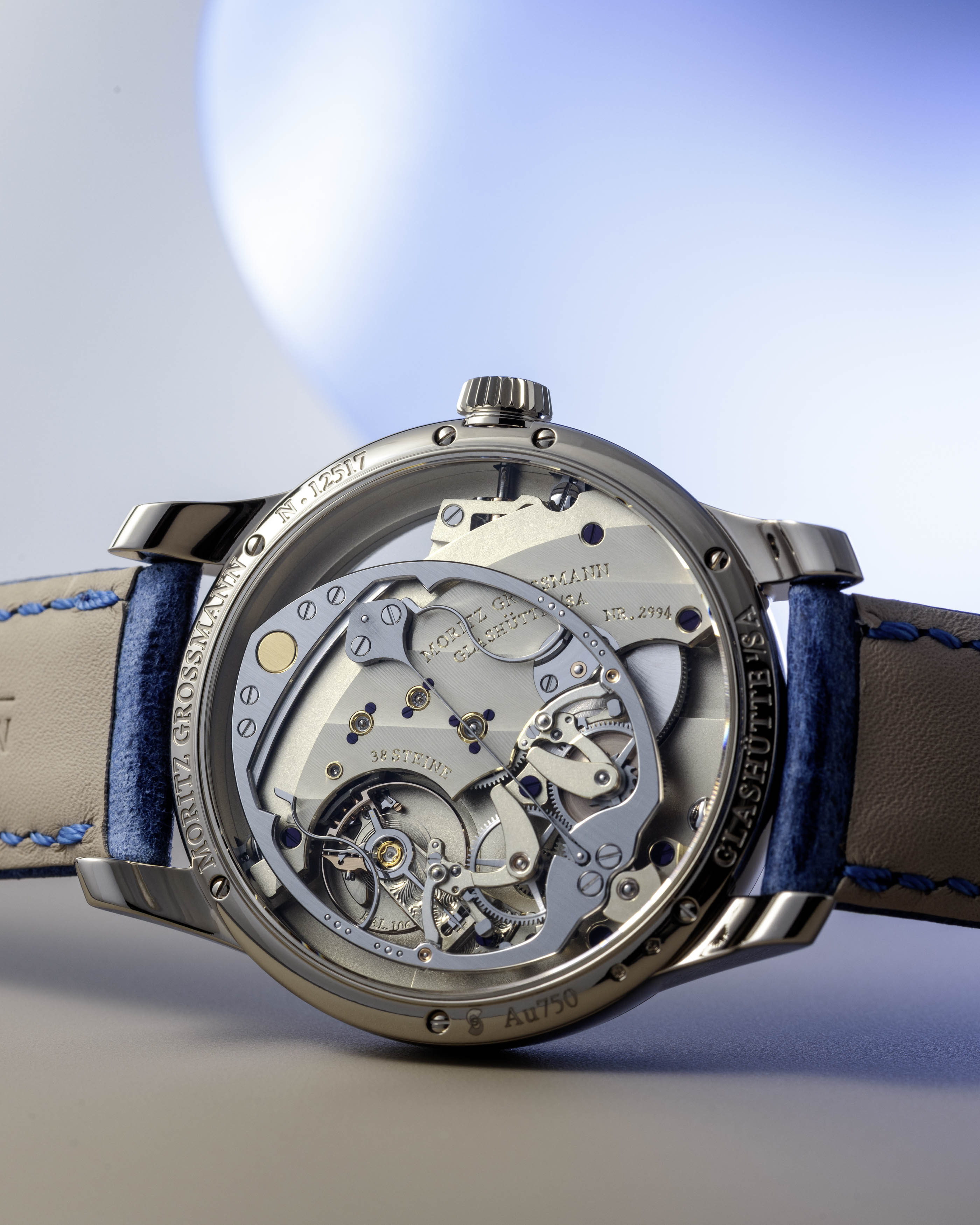
The deep black of the dial is a reminder of the power of colour. The perfectly smooth surface is so still that you feel you could dive straight into it. This effect is underpinned by the slimline, finely drawn Roman numerals that contrast sharply with their clear white and the red XII. A simple case in white gold provides the perfect backdrop, with the sides merging seamlessly into the case horns. The transparent case back offers an unrestricted view of a movement that is perfection itself, matching the finish in every detail.
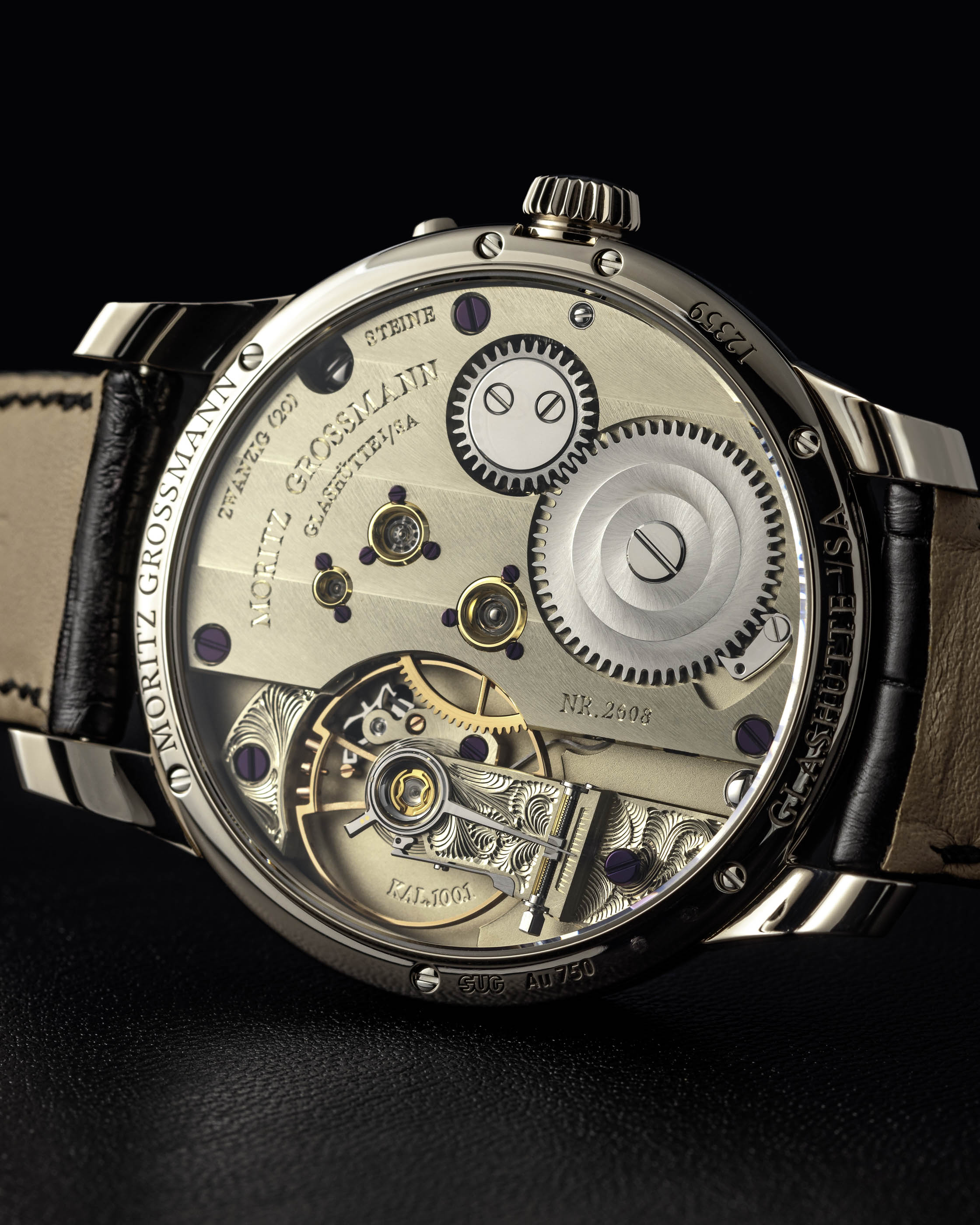
 

The art of watchmaking from Glashütte: the calibre 100.1
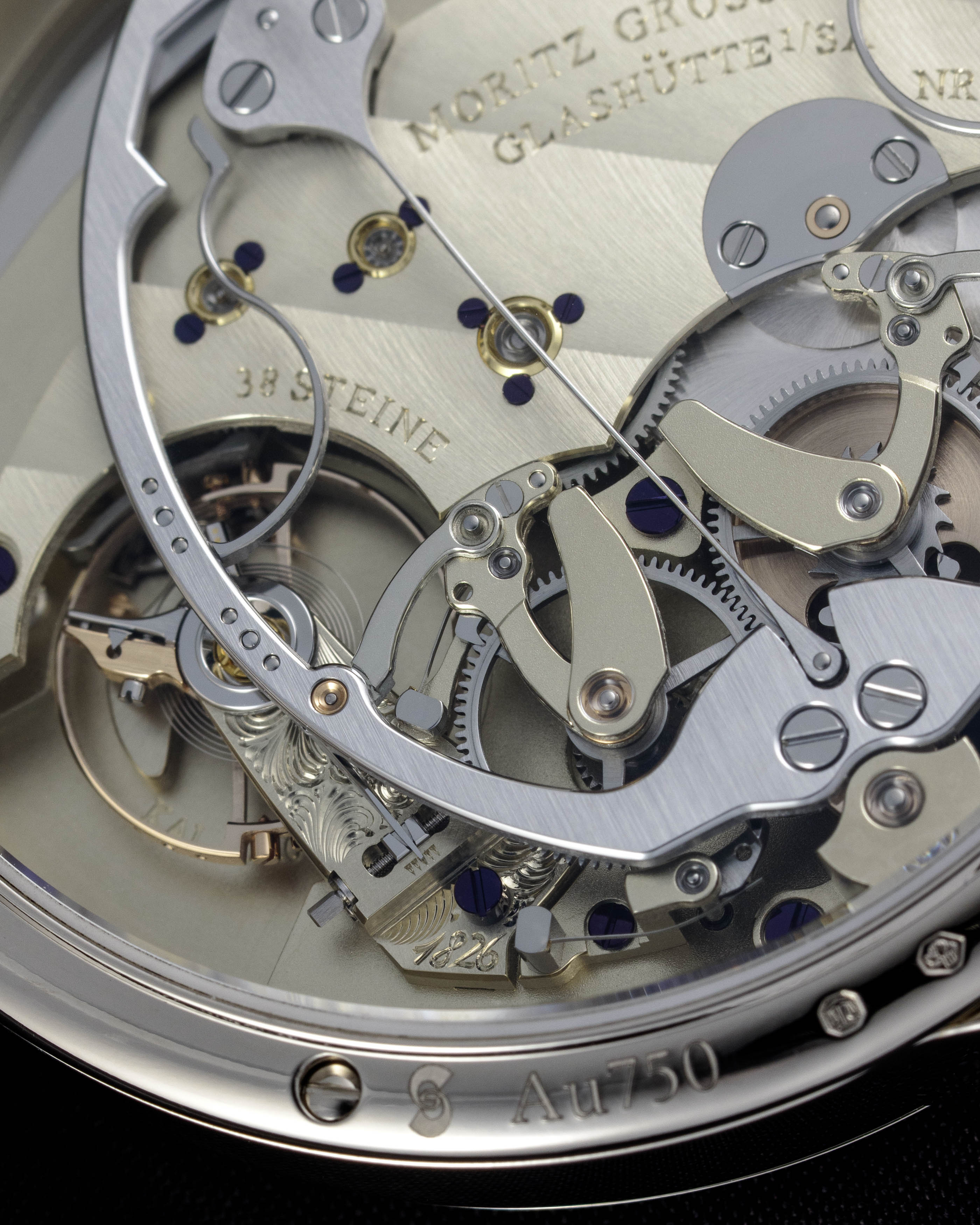
The inside of the ENAMEL ROMAN Vintage is home to the calibre 100.1, a pillar movement with well-proportioned components made from untreated German silver in a high-quality finish. The characteristic 2/3 plate with broad, horizontal ribbing has been signed by a hand engraving. It has a curved cut-out that reveals the distinctive Grossmann balance, held by a stepped, hand-engraved balance cock with the typical fine micrometer screw.

Another special feature of the manufactory movement is the perfected hand setting mechanism, which eliminates two potential problem areas: avoiding the ingress of foreign particles during the adjustment process and altering the hands unintentionally when pushing the crown back into place.

With a short pull on the winding crown, the mechanism switches to hand setting and stops the movement at the same time. The crown immediately returns to its original position, where the hands can now be precisely adjusted. The movement is then restarted using a pusher situated below the winding crown. This simultaneously resets the mechanism to its winding function.
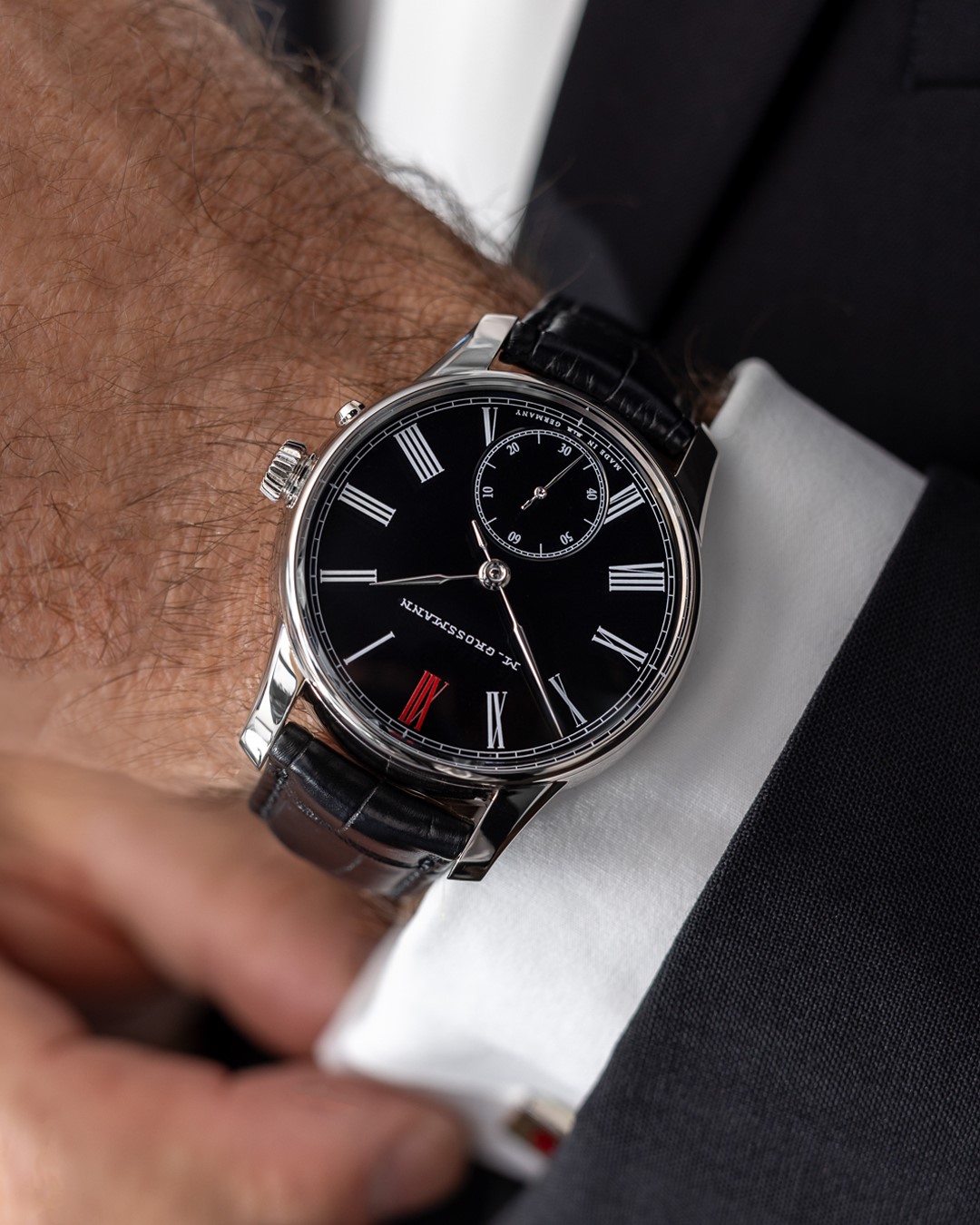
 

Exclusive special edition
The ENAMEL ROMAN Vintage in honour of the 16th anniversary of the manufactory has a case in white gold, worn on a black alligator leather strap. This special model is limited to eight pieces.
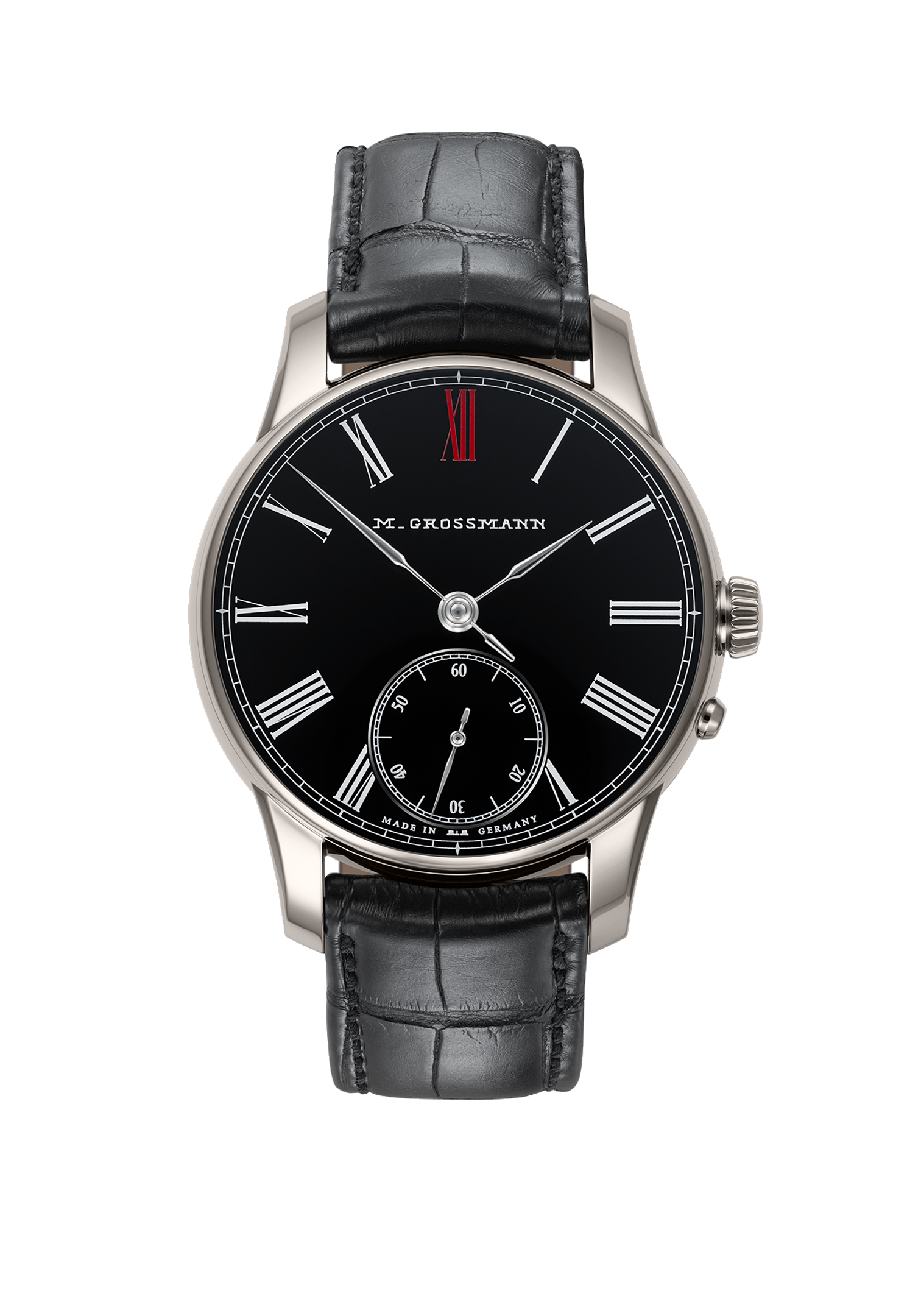
 

Enamel Roman Vintage

Technical Data


Version   Limited Edition of 8 pieces
Reference   MG-003717
     
Movement   Manufactory calibre 100.1, manual winding, regulated in five positions
No. of parts   198
Jewels   20 jewels, of which 3 in screwed gold chatons
Escapement   Lever escapement
Oscillator   Shock-resistant Grossmann balance with 4 inertia screws and 2 poising screws, Nivarox 1 balance spring with No. 80 Breguet terminal curve, Gustav Gerstenberger geometry
Balance Diameter   14.2 mm, frequency 18,000 semi-oscillations per hour
Power reserve   42 hours when fully wound
Functions   Hours and minutes, subsidiary seconds with stop second, Grossmann manual winder with pusher
Special features   Grossmann balance; hand setting override and start of movement with lateral pusher; space-saving modified Glashütte stopwork with backlash; adjustment with Grossmann micrometer screw on cantilevered balance cock; pillar movement with 2/3 plate and pillars made of untreated German silver; hand-engraved 2/3 plate, balance cock and escape-wheel cock hand-engraved; broad horizontal Glashütte ribbing; 3-band snailing on the ratchet wheel; raised gold chatons with pan-head screws; separately removable clutch winding mechanism; stop seconds for hand setting
Operating elements   Crown in 750/000 gold , to wind the watch and set the time, pusher in 750/000 gold to start the movement
Case dimensions   Diameter: 41.0 mm, height: 11.35 mm
Movement dimensions   Diameter: 36.4 mm, height: 5.0 mm
Case   Three-part, precious metal
Dial   Enamel, Roman numerals in white, XII in red
Hands   Manually crafted, polished steel
Crystal/display back   Sapphire crystal, antireflective coating on one side
Strap   Hand-stitched alligator leather with prong buckle in precious metal


Related Articles

SEPTEMBER 19 2025    |    Novelties

Armin Strom Unveils the Tribute 1 Green: A Celebration of Nature’s Elegance

Armin Strom introduces the Tribute 1 Green, a refined dress watch that pays homage to the timeless beauty of nature. Limited to just 50 pieces, this new release brings forest-inspired tones to the brand’s most elegant collection, combining artisanal craftsmanship with modern mechanical innovation.

A Forest-Inspired Masterpiece

The Tribute 1 Green features a striking off-centre dial in forest green, adorned with a hand-engraved grain d’orge guilloché pattern and crisp white Roman numerals. A frosted subdial adds depth and texture, while the green Alcantara leather strap with off-white stitching completes the composition with understated sophistication. The openworked motor barrel, secured by a polished finger bridge in stainless steel, echoes the case design and showcases Armin Strom’s signature fusion of symmetry and mechanical artistry. The 38 mm stainless steel case, with anti-reflective sapphire crystals front and back, ensures optimal clarity and elegance.

Exceptional Performance

At the heart of the Tribute 1 Green is the manual-winding Manufacture Caliber AMW21, offering an impressive 100-hour power reserve. This is made possible by the brand’s patented equal force barrel, designed for efficiency and compactness. Operating at 25,200 vibrations per hour (3.5 Hz), the movement reflects Armin Strom’s technical mastery, with 97% of components produced in-house.

Haute Horlogerie, Hand-Finished

Every Tribute 1 Green is a testament to traditional watchmaking. The case features brushed and polished surfaces, finished entirely by hand. Inside, the movement is decorated with Geneva stripes, circular graining, and a mirror-polished finger bridge, all executed by Armin Strom’s skilled artisans.

True to the brand’s commitment to excellence, each watch is assembled twice—once for mechanical precision and again after decoration—to ensure the highest standards of performance and aesthetics.  

View Watch Gallery
Image 1 Image 2  
View More
OCTOBER 17 2025    |    Novelties

Armin Strom Unveils Mirrored Force Resonance Zeitgeist 1665 – A Tribute to Horological History

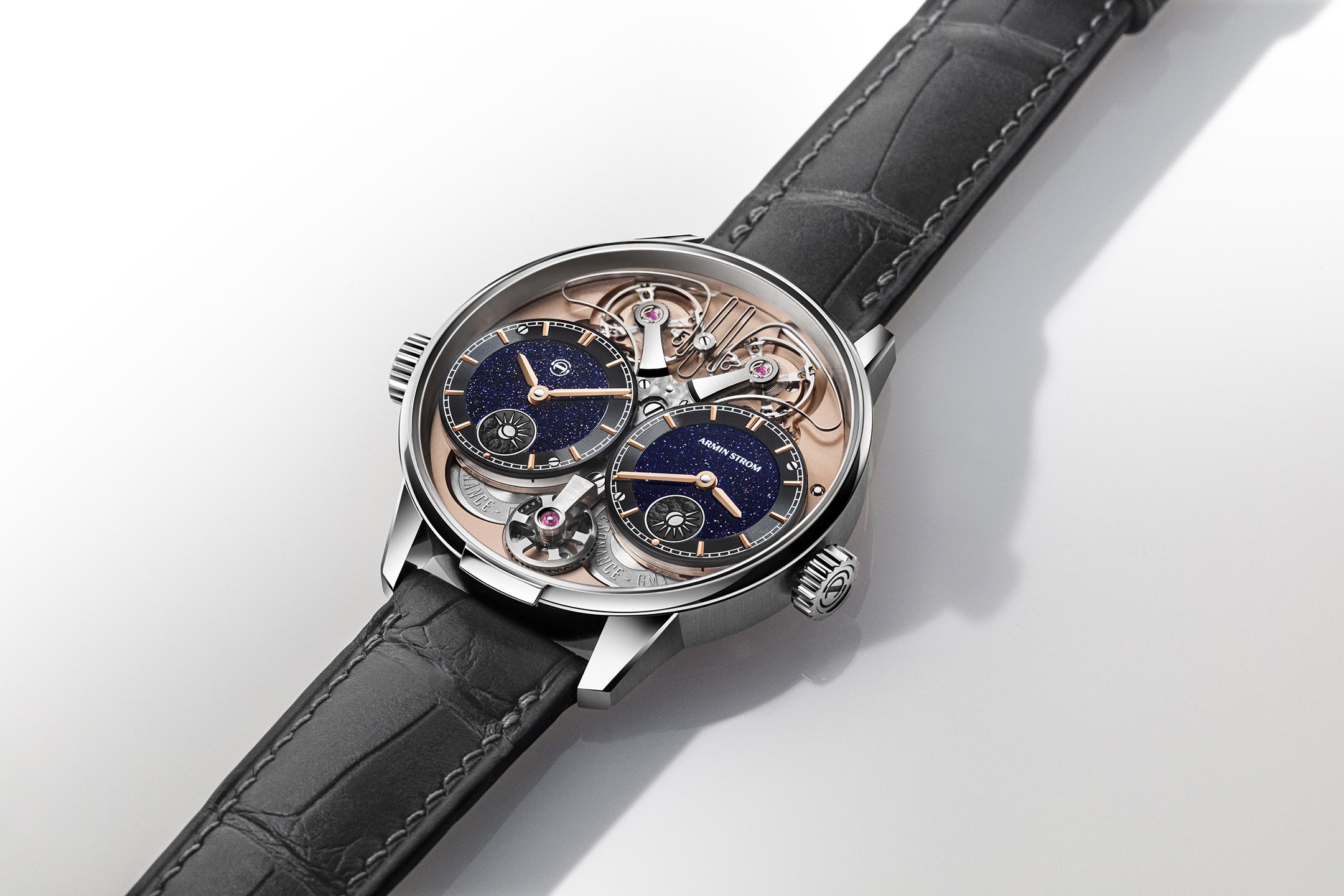
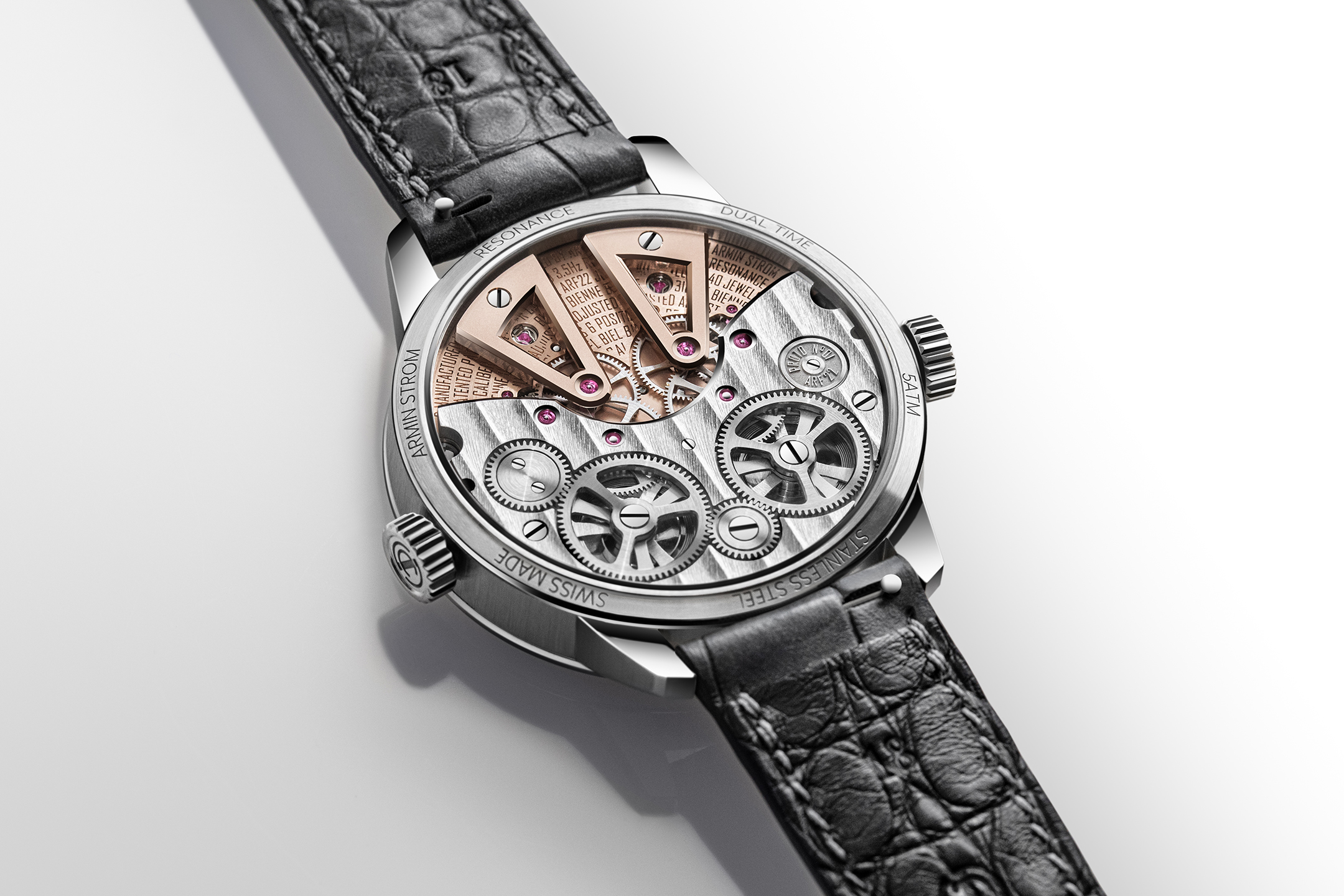
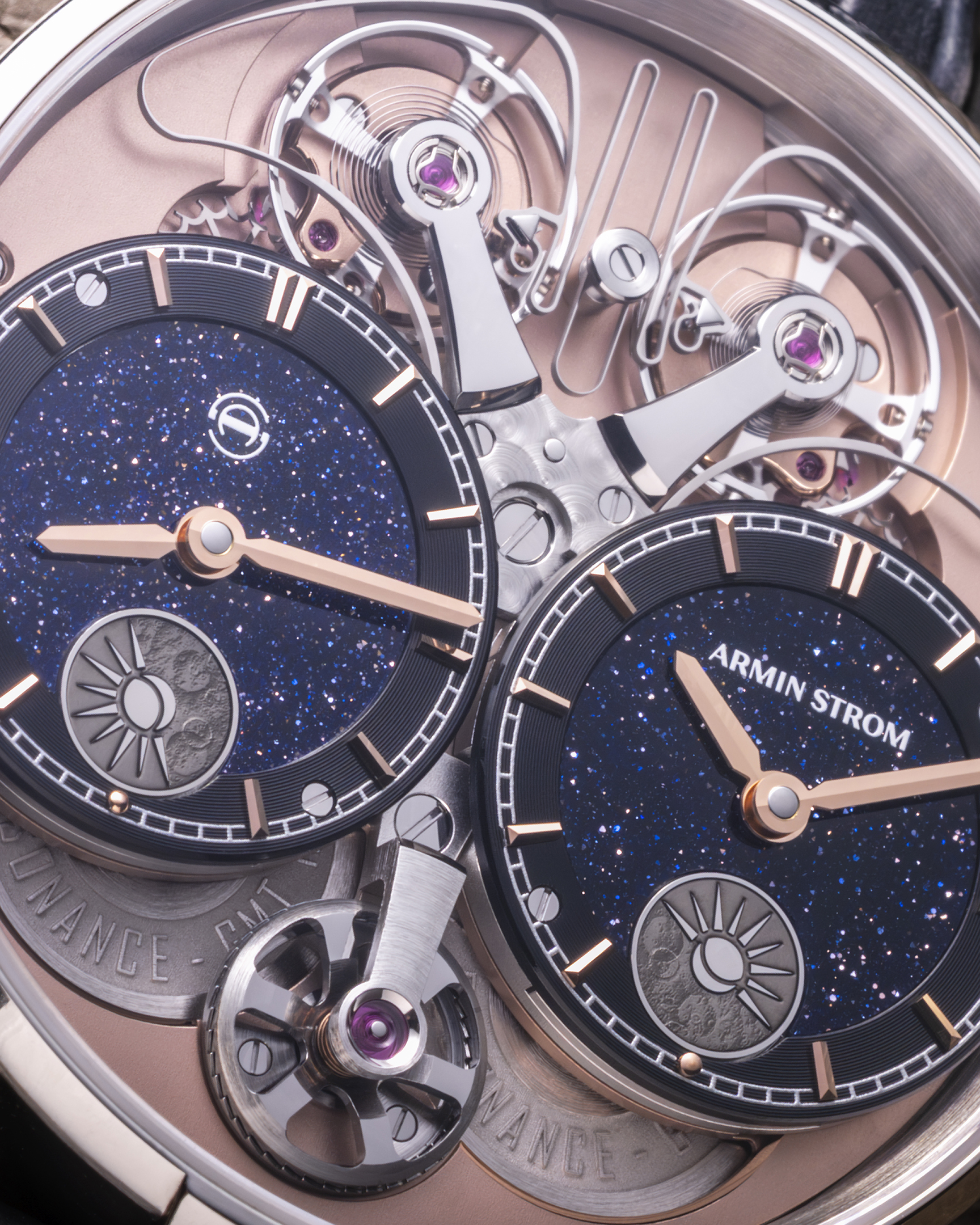
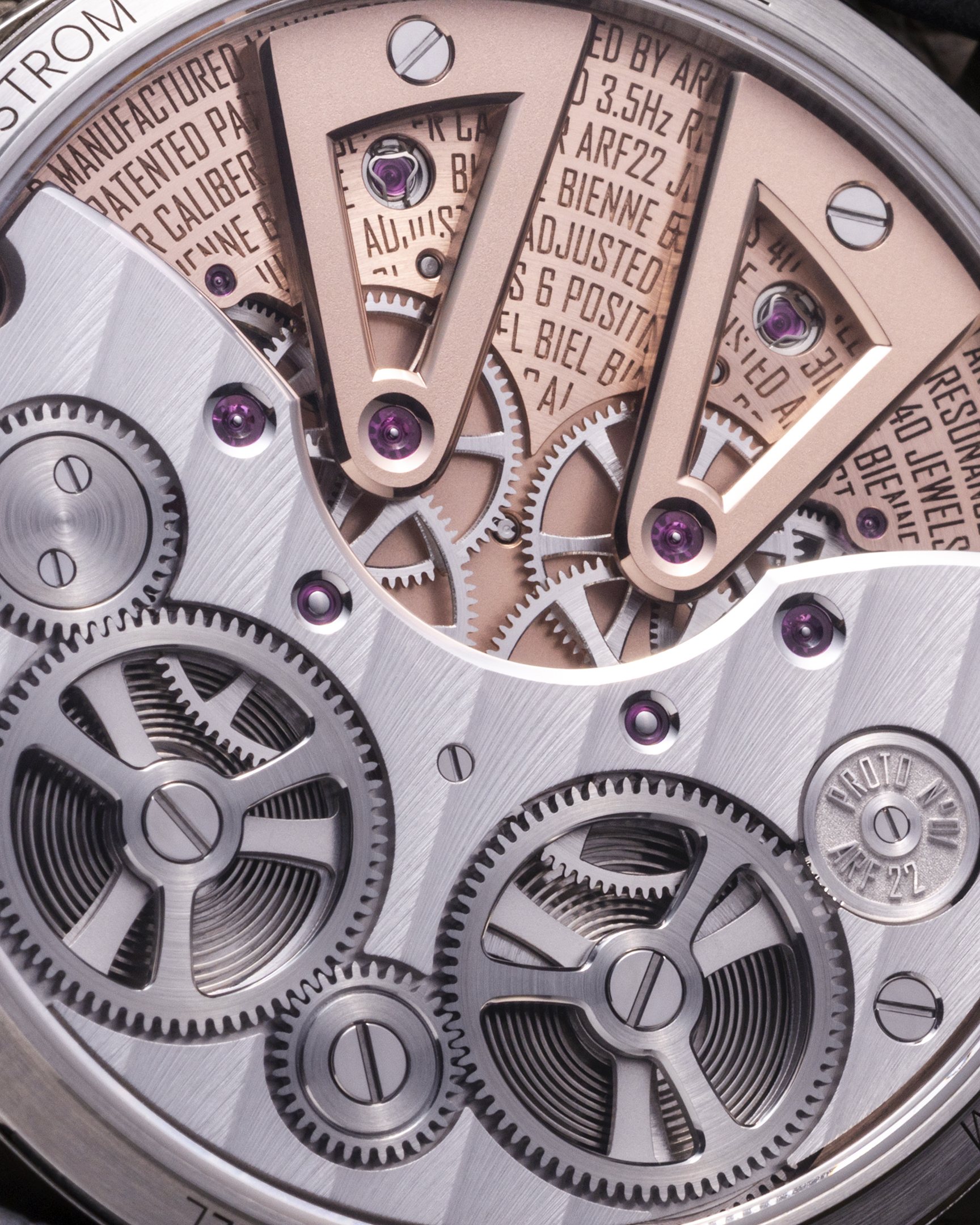
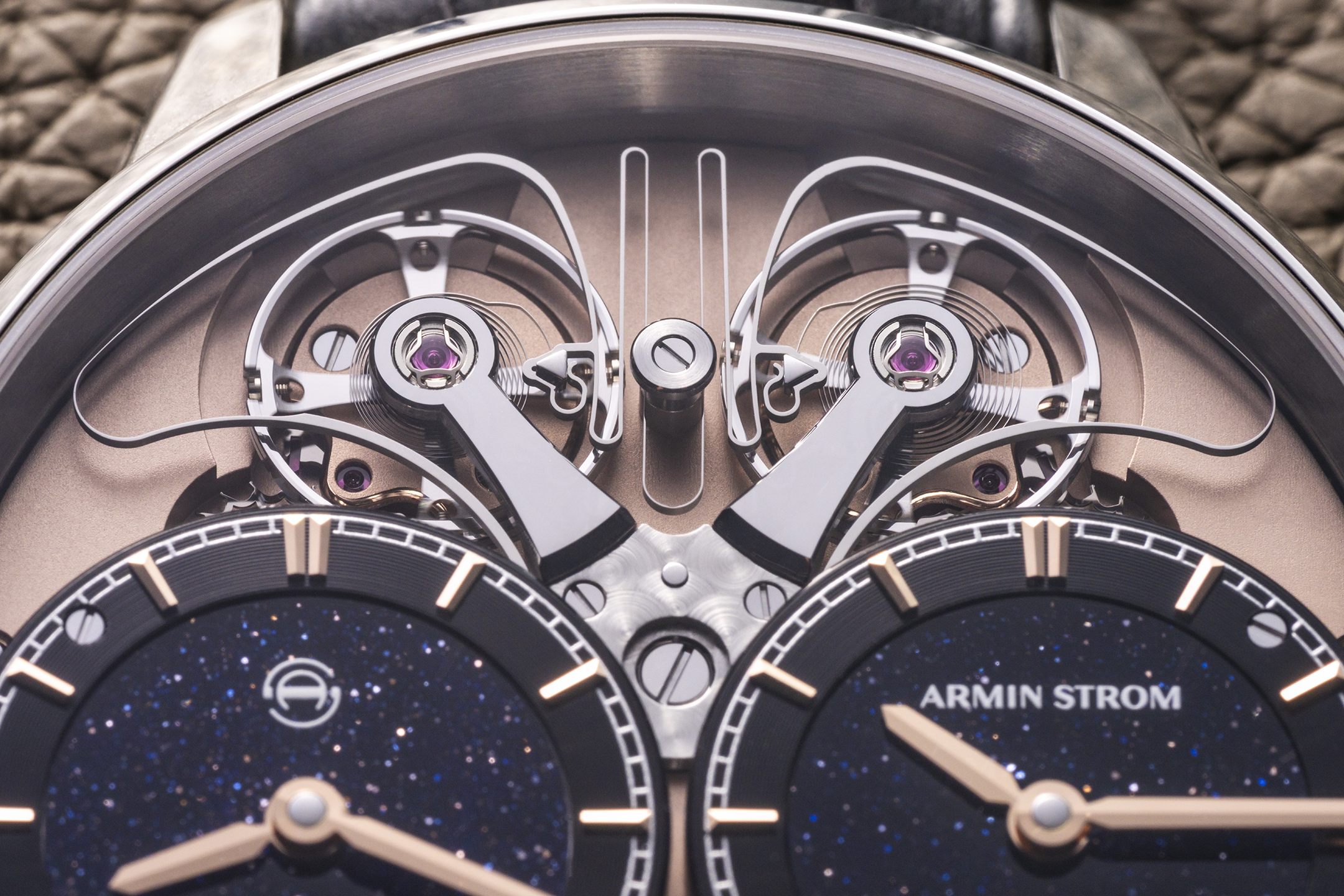
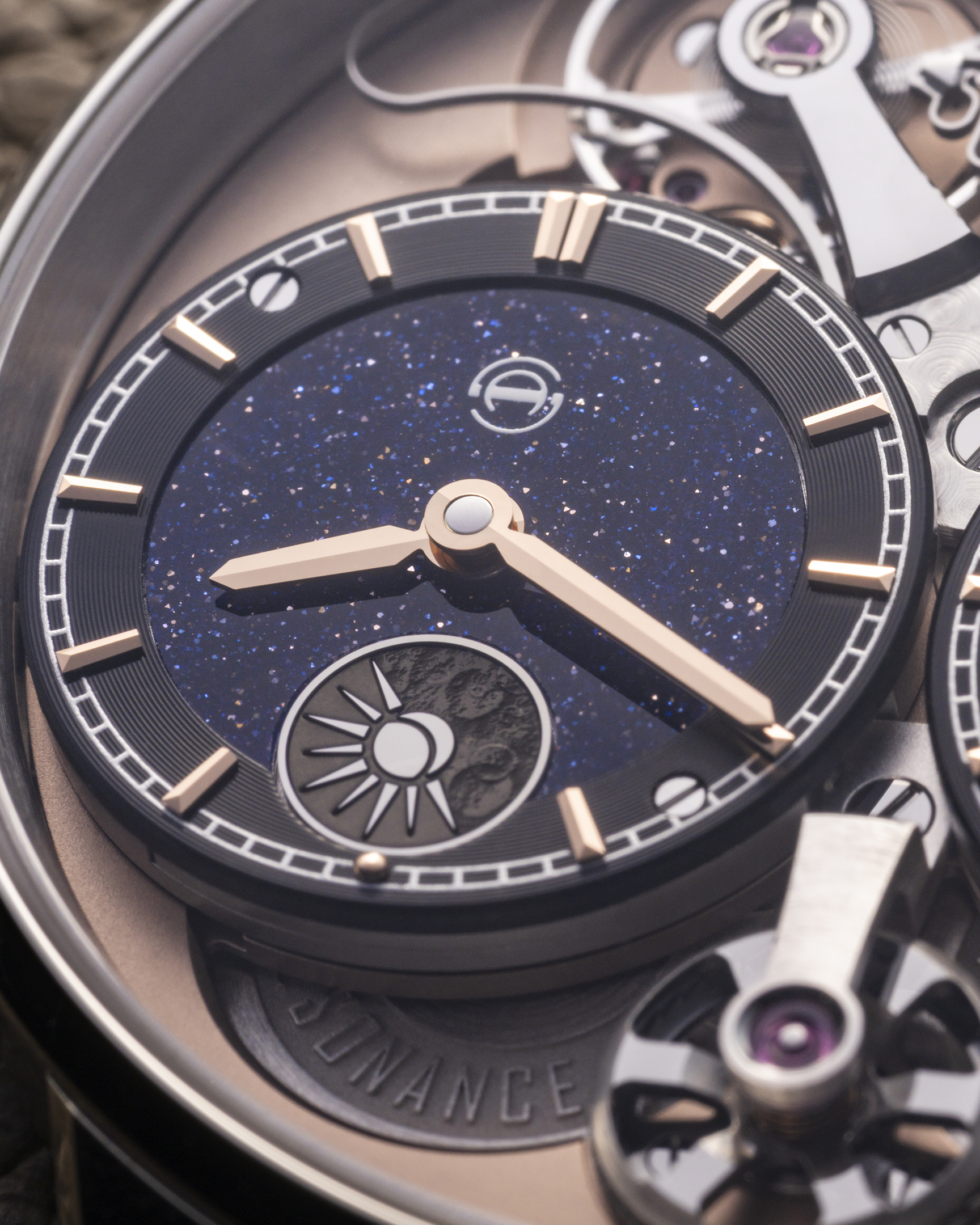
Armin Strom unveils the Mirrored Force Resonance Zeitgeist 1665, a creative interpretation of what a Resonance wristwatch might have looked like centuries ago. This timepiece combines historical horology with modern innovation, celebrating the brand’s milestone achievement of stable and resilient Resonance.

The Zeitgeist features a stainless steel case measuring 43 mm in diameter, paired with an 18K white gold dial in an off-center design. Inside beats the Armin Strom Manufacture Caliber ARF21_ZG, a manual-winding movement with twin-seconds and flyback functionality, offering an impressive 80-hour power reserve. Limited to just 25 pieces worldwide, this exceptional creation pays tribute to the centuries-long pursuit of chronometric consistency, a challenge first explored by Christiaan Huygens in 1665. Armin Strom solved the Resonance Fragility Problem in 2016, making this phenomenon practical for wristwatches.


View Watch Gallery
Image 1   
View More
APRIL 07 2026    |    Watches and Wonders 2026

The HM Pietersite: A Tribute to the Spirit of Exploration and the Art of the Ultra-Thin

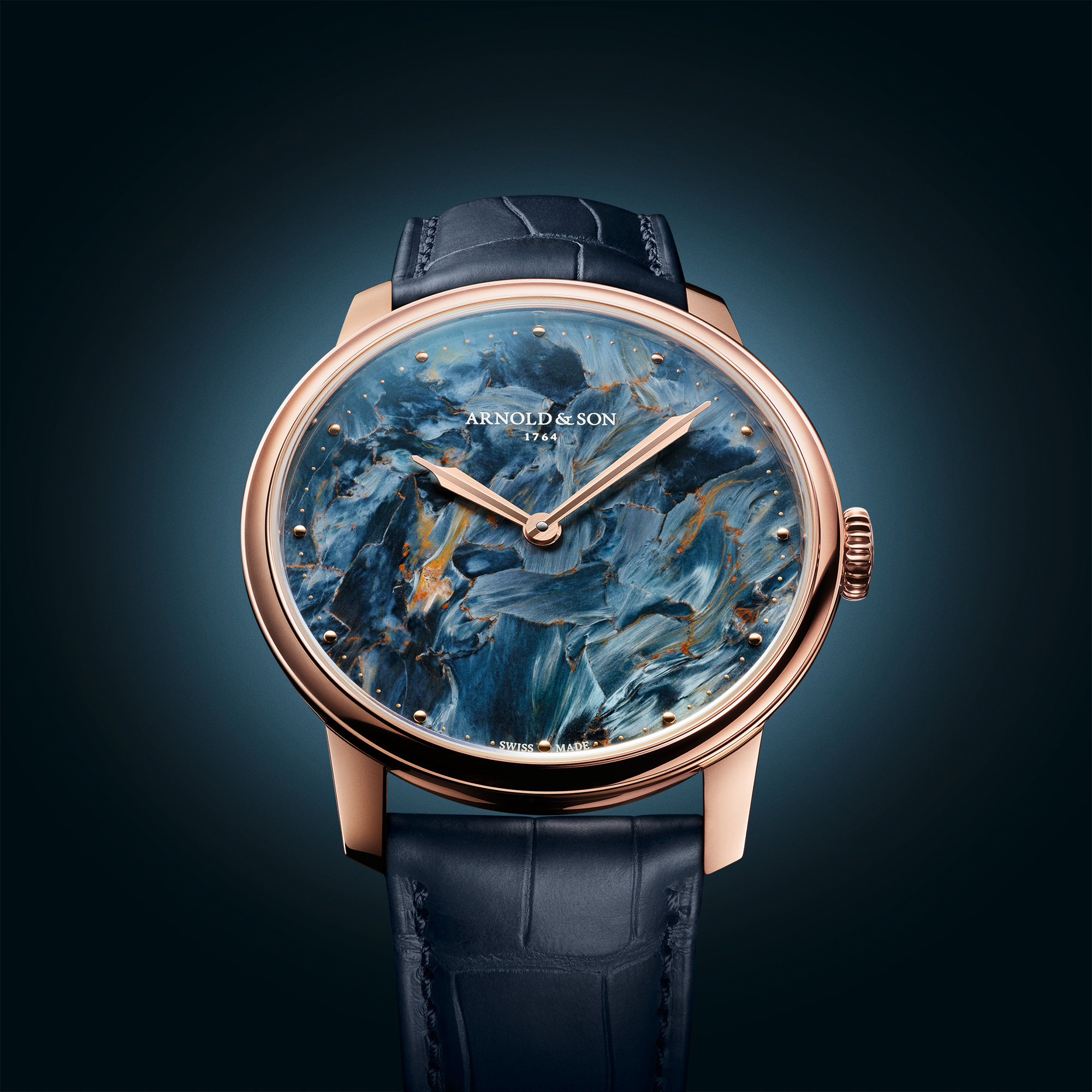
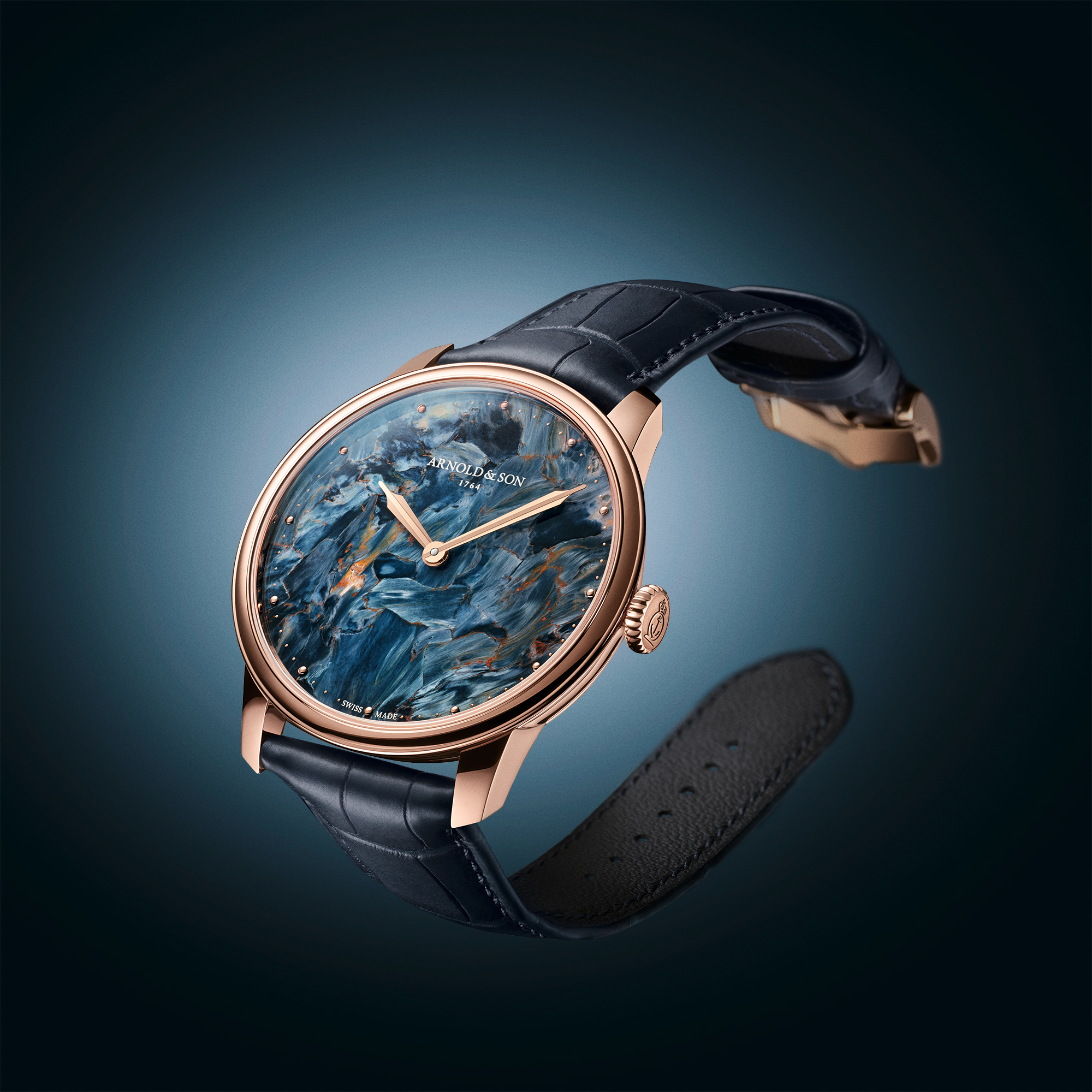
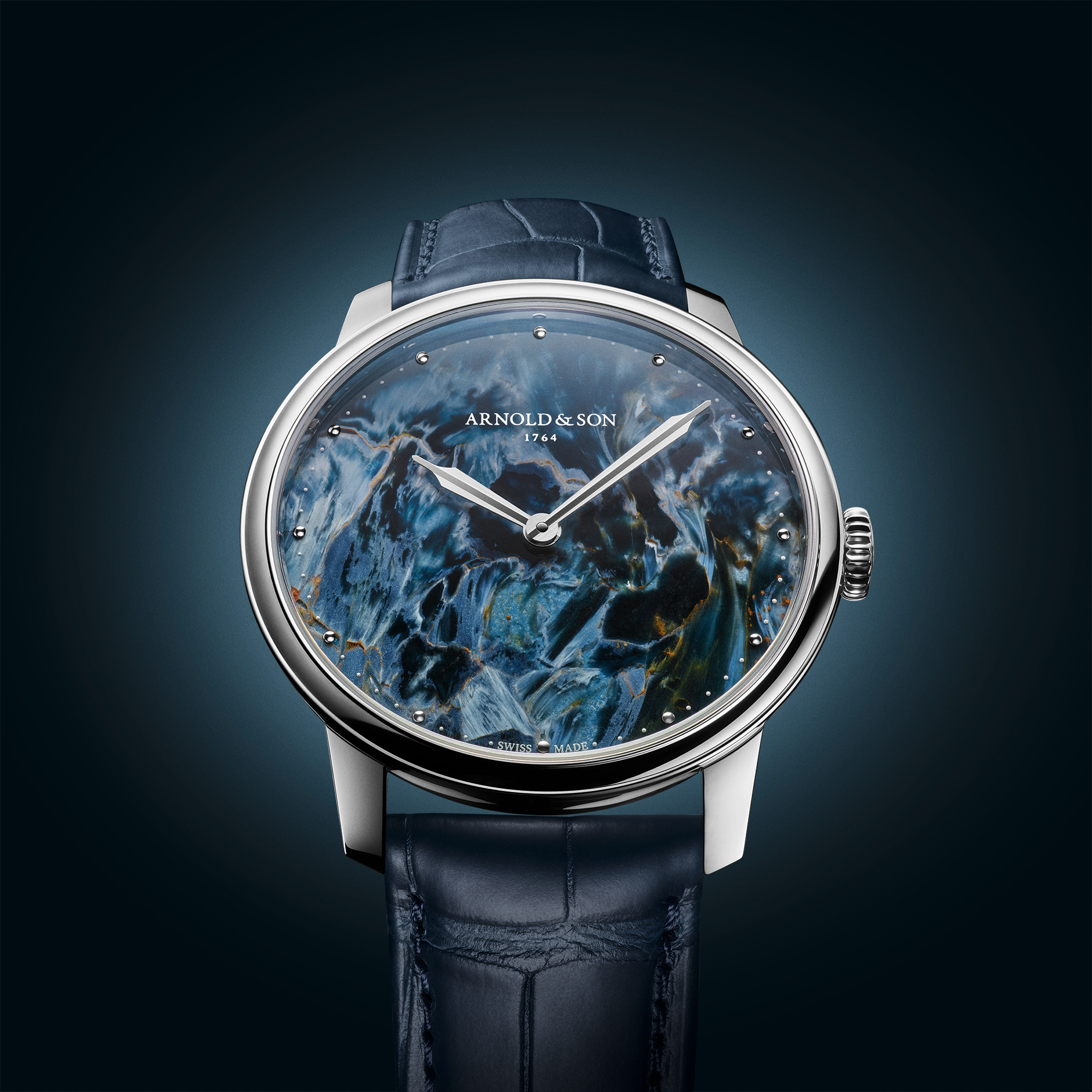
Arnold & Son presents two new evocative versions of its ultra-thin HM model, featuring dials crafted from Namibian pietersite. Often called the "stone of storms," this decorative mineral belongs to the chalcedony family and was first discovered by Sid Pieters in the early 1960s. Each unique dial displays delicate, swirling patterns that recall the turbulent skies and foaming waves of Cornwall, the English birthplace of founder John Arnold. This design pays tribute to the ingenuity of the legendary watchmaker while celebrating the spirit of those who maintain their course in a challenging world.

The designation "HM" was intentionally chosen to reflect the watch's focus on displaying only hours and minutes, while simultaneously serving as a historical nod to the British Royal Navy. In naval tradition, HM stands for "His or Her Majesty’s," a title that appeared in the 17th century and was later formalized as HMS. By transposing this reference to watchmaking, Arnold & Son connects the precision of modern horology with England's maritime history, specifically the era when John Arnold’s marine chronometers enabled the exploration of new lands.

Encased in a choice of 18-carat red gold or stainless steel, the HM Pietersite is a masterpiece of elegance and restraint. The case measures a refined 39.5 mm in diameter with a remarkably slim profile of just 7.82 mm. To complement the dreamlike, diaphanous patterns of the pietersite dial, the timepiece is paired with a matte ink-blue alligator leather strap and a traditional pin buckle crafted from the same metal as the case. These limited editions are produced in extremely small quantities, with only 8 pieces available in red gold and 18 in steel.

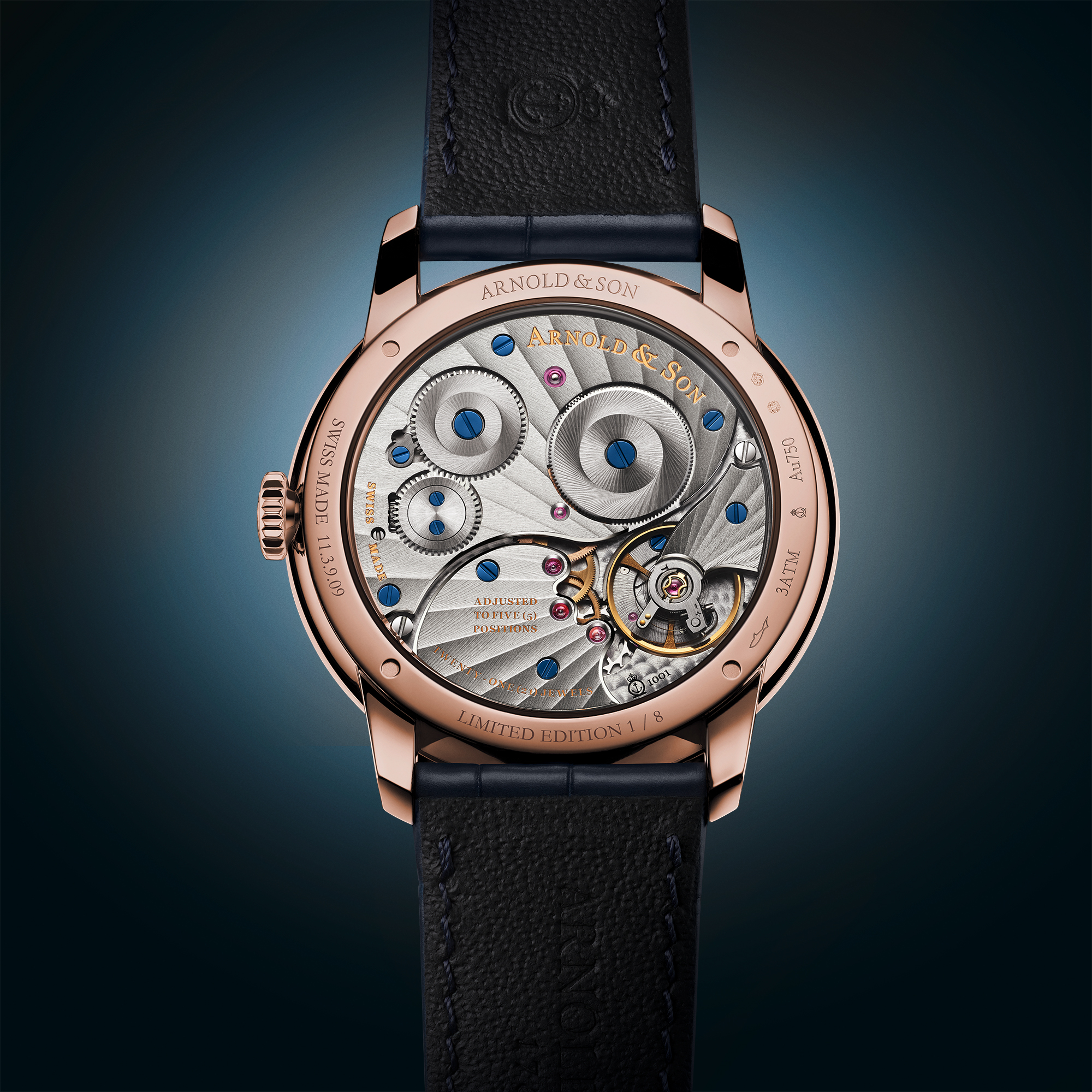
At the heart of this timepiece lies the ultra-thin, in-house A&S1001 manual-winding calibre. Visible through a sapphire crystal case back, the movement is a showcase of luxury finishing, featuring a rhodium-plated main plate with circular graining and bridges adorned with radiating Côtes de Genève. Despite its slender height of only 2.70 mm, the movement offers exceptional performance with a generous 90-hour power reserve. Every detail, from the snail-finished wheels to the blued screws with polished heads, reflects the most exacting standards of Swiss watchmaking.

View Watch Gallery  
Image 1  Image 2 Image 3  Image 4       
View More
JULY 02 2025    |    Novelties

Greubel Forsey Unveils the Final Balancier Contemporain in Stainless Steel - A Defining Final Edition

Greubel Forsey presents the final edition of the Balancier Contemporain, marking the definitive conclusion of this iconic calibre. This timepiece is housed in a 39.6mm stainless steel case – a material that has only been used twice before in the history of the Atelier. Limited to just 33 timepieces, this edition will be built and delivered exclusively in 2025. Once complete, the Balancier Contemporain calibre will be permanently retired and will never be made again.

More than a final edition, this stainless steel interpretation is a statement of purpose – it is the rarest and most exclusive case material in the Atelier’s repertoire. Its presence here is deliberate: to honour the legacy of the Balancier Contemporain with purity, restraint, and resolve.

Compact, Yet Monumental

When it was introduced, the Balancier Contemporain redefined expectations – delivering the full Greubel Forsey experience in just 39.6mm. This final edition preserves that feat of engineering and design. Under its high-domed sapphire crystal, the gold dial reveals a rich interplay of levels, textures, and finishes. A sunburst blue hour-ring frames the composition, while a deep blue minute-circle and sectorial indications for the small seconds and power reserve create both contrast and clarity. A large visual opening draws the eye to the in-house 12.6mm balance wheel, suspended above a flat, black-polished gold plate that provides visual depth and dramatic reflection.

The movement is composed of 256 parts, each hand-finished to the highest standard. The bridges are in nickel silver, frosted and spotted by hand, with perfectly polished bevels and countersinks, straight-grained flanks, and a subtle blue treatment unique to this edition. The balance wheel bridge is flat black polished steel – one of the most demanding finishes in haute horlogerie – with hand-polished bevels that reflect light beautifully. The balance wheel itself is mounted above a flat black-polished gold plate, a surface so refined it becomes both technical and architectural.

On the movement side, a black-polished gold plate is engraved in relief with the fundamental values of Greubel Forsey – invisible to the wearer, yet finished with the same uncompromising care. Olive-domed jewels are set in gold chatons, with hand-polished countersinks that catch the light at just the right angle. Every component, visible or not, is treated with the same reverence – as if each part could stand on its own as a miniature work of art.

A Closing Statement – and a New Beginning

This is the last timepiece to carry the Balancier Contemporain calibre – but it is also the first to signal a new direction. With this final edition, Greubel Forsey opens a new chapter focused on small-diameter timepieces. Over the coming years, this creative momentum will continue to build, exploring new dimensions of mechanical expression, proportion, and elegance – all without compromise.

The Balancier Contemporain in stainless steel is a definitive conclusion – and a confident beginning.
 

View Watch Gallery
Image 1 Image 2Image 3 Image 4  
View More
NOVEMBER 19 2025    |    Novelties

DANIEL ROTH Unveils Tourbillon Platinum: A Masterpiece of Horological Revival

DANIEL ROTH proudly presents the Tourbillon Platinum, a timepiece that pays homage to the brand’s rich heritage and its founder’s enduring passion for the tourbillon complication. This exceptional creation is inspired by the 1988 reference C187 and reinterprets it with modern refinement, artisanal craftsmanship, and a noble platinum case.

The signature double-ellipse case, now crafted in platinum, measures 38.6 x 35.5 mm and is just 9.2 mm thick. It houses a hand-guilloché dial made of solid white gold, finished in anthracite and accented with a sterling silver chapter ring. The dial’s linear guilloché pattern is executed by a single Maître Guillocheur over three days, reflecting the brand’s commitment to traditional métiers d’art.

Inside beats the DR001 calibre, a manually wound movement developed by Michel Navas and Enrico Barbasini at La Fabrique du Temps Louis Vuitton. Comprising 206 components, it offers an 80-hour power reserve and operates at 3Hz. The movement is entirely hand-finished, including hidden components, and features a triple-arm seconds hand—a nod to Daniel Roth’s original design language.

The Tourbillon Platinum is the third model in the brand’s rebirth, following the Tourbillon Souscription and the rose gold edition. It offers a more contemporary aesthetic while remaining faithful to the brand’s DNA of mechanical excellence and elegant restraint.

View Watch Gallery
Image 1 Image 2Image 2Image 2Image 2
View More
JUNE 29 2026    |    Novelties

Greubel Forsey Introduces the Balancier QM: A New Pinnacle of Haute Horlogerie

Independent manufacture Greubel Forsey has unveiled the Balancier QM ($GF09cm$), marking a historic milestone for the workshop by officially naming its highest, most uncompromising hand-finishing standard: Qualité Musée (Museum Quality). While this meticulous level of execution has been quietly embedded into every single timepiece crafted by the Atelier since its founding in 2004, the Balancier QM is the first model to formally carry the designation. Driven forward by a dedicated research wing within the brand’s proprietary EWT (Experimental Watch Technology) Laboratory, this standard mandates that every individual component, whether fully visible through the sapphire crystals or buried deep within the gear train, must hold up as a standalone work of art.

The mechanical architecture of the Balancier QM is a tour de force of in-house micro-engineering and innovation. Most notably, the timepiece features a specialized hairspring manufactured entirely in-house from the raw alloy stage up—a rarity in modern watchmaking accomplished via restored antique machinery. This is paired with an impressive $12.60\text{ mm}$ variable-inertia balance wheel and a cutting-edge bi-level escapement system that utilizes unique convex pallet-jewels, allowing light to softly diffuse through the rubies rather than abruptly reflecting off flat surfaces. Illustrating the immense labor required for the Qualité Musée standard, the steel balance wheel bridge alone requires seven distinct hand-finishing techniques, ranging from flawless mirror barrel polishing to extra-large $0.40\text{ mm}$ hand-polished bevels.

Visually, the timepiece presents an intricately layered, three-dimensional landscape neatly organized within a highly compact 39.60mm white gold case. The movement architecture encourages deep visual exploration; the escapement is nestled into the lowermost depths of the chassis, while the eye naturally ascends past a high-set small seconds sub-dial, flame-blued polished steel hands, and a raised chapter ring. Beneath this upper track, a power-reserve indicator slips mysteriously across a dedicated sector to track the watch's 72-hour chronometric power delivery, sustained by two fast-rotating, series-coupled mainspring barrels. True to Greubel Forsey’s signature underplayed luxury, the words "Qualité Musée" are entirely absent from the dial, hidden instead on a secret internal plate deep inside the movement.

Limited to just 33 exclusive timepieces worldwide, the Balancier QM represents a deliberate strategic pivot for Greubel Forsey toward smaller, more wearable case dimensions without sacrificing an ounce of technical complexity. The manufacture openly acknowledges that achieving this level of structural perfection across all 298 movement parts demands an extraordinary expenditure of time, which will intentionally reduce the company's overall production volume heading into 2027. Looking ahead, the Qualité Musée standard will serve as the foundation for a series of compact releases, including a highly anticipated movement under development at the EWT lab featuring a gear train crafted entirely from solid gold.


View Watch Gallery  
Image 1  Image 2 Image 3  Image 4
View More
ENDLESS DISCOVERY IN YOUR INBOX
Join our mailing list to receive insider updates on our latest collections, invites to private events, and other personalized offerings.