Shopping Cart

To mark the 16th anniversary of the manufactory, Moritz Grossmann presents the limited-edition ENAMEL ROMAN Vintage

NOVEMBER 13 2024    |    Novelties

Black is the absence of light. This is the physical definition of a colour that is synonymous with classicism and elegance. At Moritz Grossmann, black is used to form stylish contrasts and also serves as a testament to the highest standards of craftsmanship. The limited-edition ENAMEL ROMAN Vintage, for example, has an enamel dial whose manufacture presents multiple challenges. With this, Moritz Grossmann has chosen the occasion of its 16th birthday to once again shine the spotlight on the expertise of the ateliers and workshops in Glashütte.

Tradition requires renewal, otherwise it remains stagnant in the past and cannot survive. This is an approach that Moritz Grossmann has embodied since 2008: the manufactory opened 16 years ago as a tribute to one of the most exceptional personalities in the history of watchmaking in Glashütte. Moritz Grossmann was an innovative watchmaker and, with the founding of the German Watchmaking School in Glashütte, influenced a generation of artisans.

His values and vision now live on in the Moritz Grossmann manufactory, which crafts a small but exquisite collection of sophisticated watches that always remain true to the standards of the man who gave the manufactory its name. Characteristics of these timepieces include exclusive manufactory movements with innovative details that are designed, made and finely decorated in-house in the company’s own workshops. The highest of standards also come into play when finishing the watches, as impressively demonstrated by the special model marking the 16th anniversary of the manufactory.
 

ENAMEL ROMAN Vintage: contemporary craftsmanship honouring the 16th anniversary of the manufactory
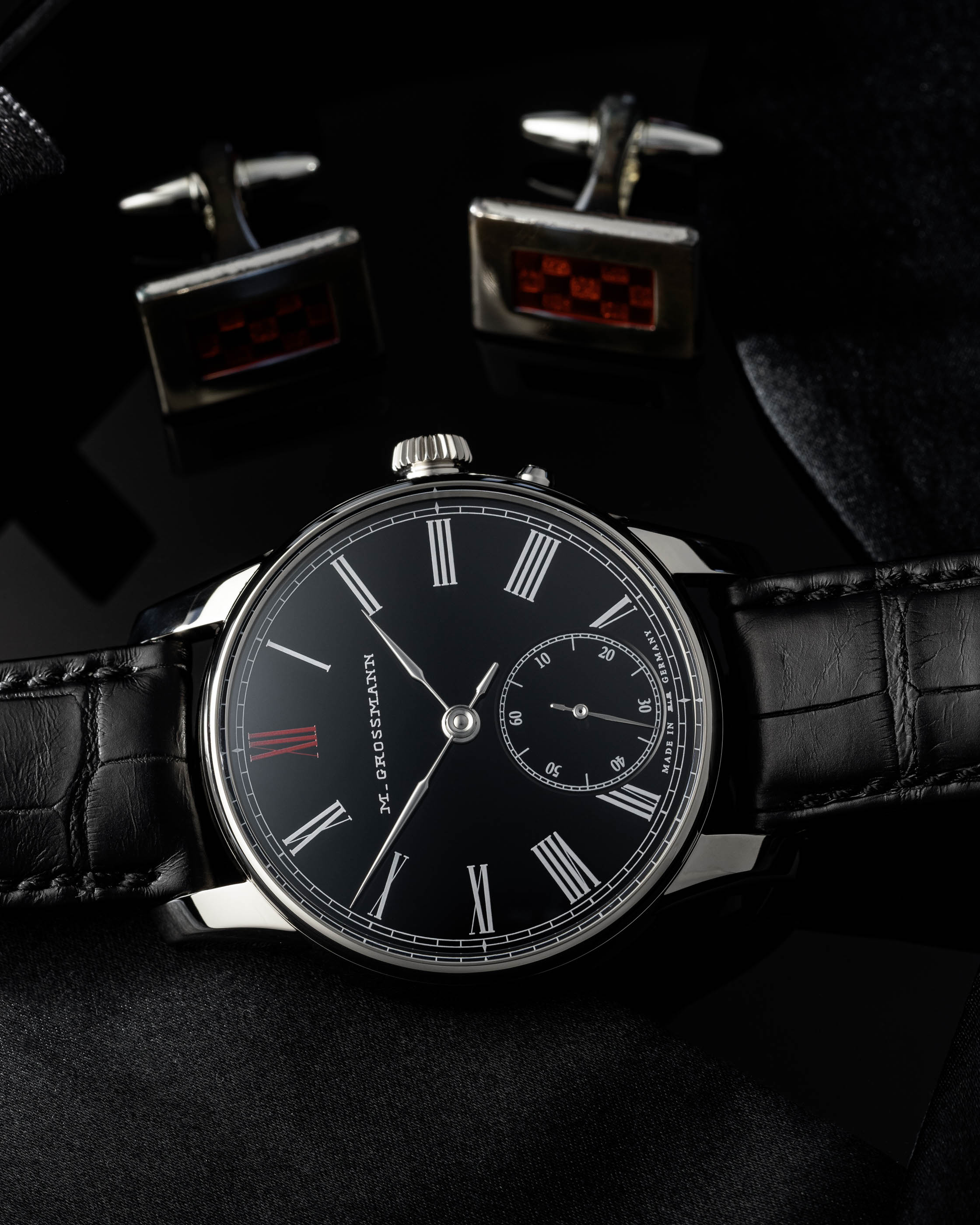
The ENAMEL ROMAN Vintage, which is limited to eight pieces, serves as a contemporary interpretation of the company's philosophy: its theme is the contrast between black, white and red, which brings the art of watchmaking as cultivated by Moritz Grossmann into the modern age.

The deep, perfect shade found on the dial draws the eye. It is rooted in the technique of enamelling, an ancient craft. The oldest known enamels date from the centuries before Christ, when artistic enamels were already being used by people in East Asia and the ancient Egyptians. Later, the art of enamelling experienced a heyday in Byzantium and also in Europe. Even early on, people marvelled at enamel because of its colourfulness, beauty and radiance, and later it was prized for its characteristics, including durability, the fact that it does not age, is smooth and has a fine yet subtle sheen.

As pocket watches started to be made, enamel gained in importance when it came to the production of dials. Its use spread to Saxony, where the art of enamelling was cultivated in gold and silversmithing. In the 17th and 18th centuries, for example, Georg Friedrich Dinglinger, a brother of the well-known Dresden court goldsmith Melchoir Dinglinger, produced some impressive works. Both artists worked under the patronage of Augustus the Strong, Elector of Saxony and King of Poland. Works of art from their workshops can today be admired at the Grünes Gewölbe in Dresden.
 

The art of enamelled dials
With the renaissance of the mechanical watch, the enamel dial has gained admirers once again. It is treasured not only for its beauty, but also because people are now aware of what is involved in its creation, a complex process that requires much skill. Enamel is formed from glass and other additives. The enamel granules are pulverised, with metal oxides or ceramic pigments lending them their colour. The enamel is then sieved while dry or applied to a dial blank as part of a blend of enamel powder, water and glue. Following the first round of firing and cooling, enamel powder is once again applied to the front and it is fired again. This process of firing, applying enamel powder and firing again is repeated several times.

Layer by layer, this creates a uniform, shiny surface that can be printed with numerals or indices following the final firing. The finished dial is impressively durable: there are no time limits on enamel and it can last for a thousand years.
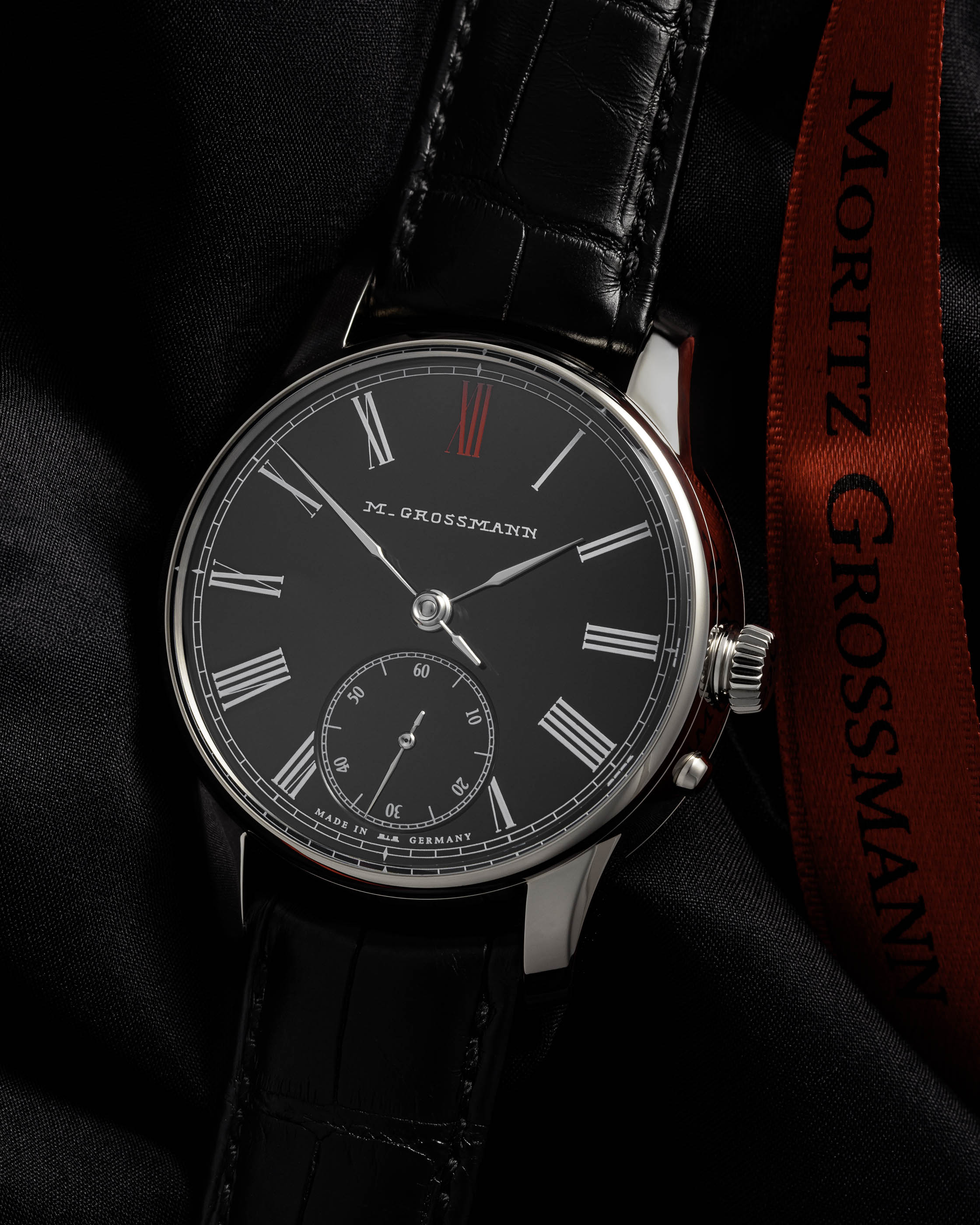
 

Approximately 90 steps are involved in creating a single dial for Moritz Grossmann
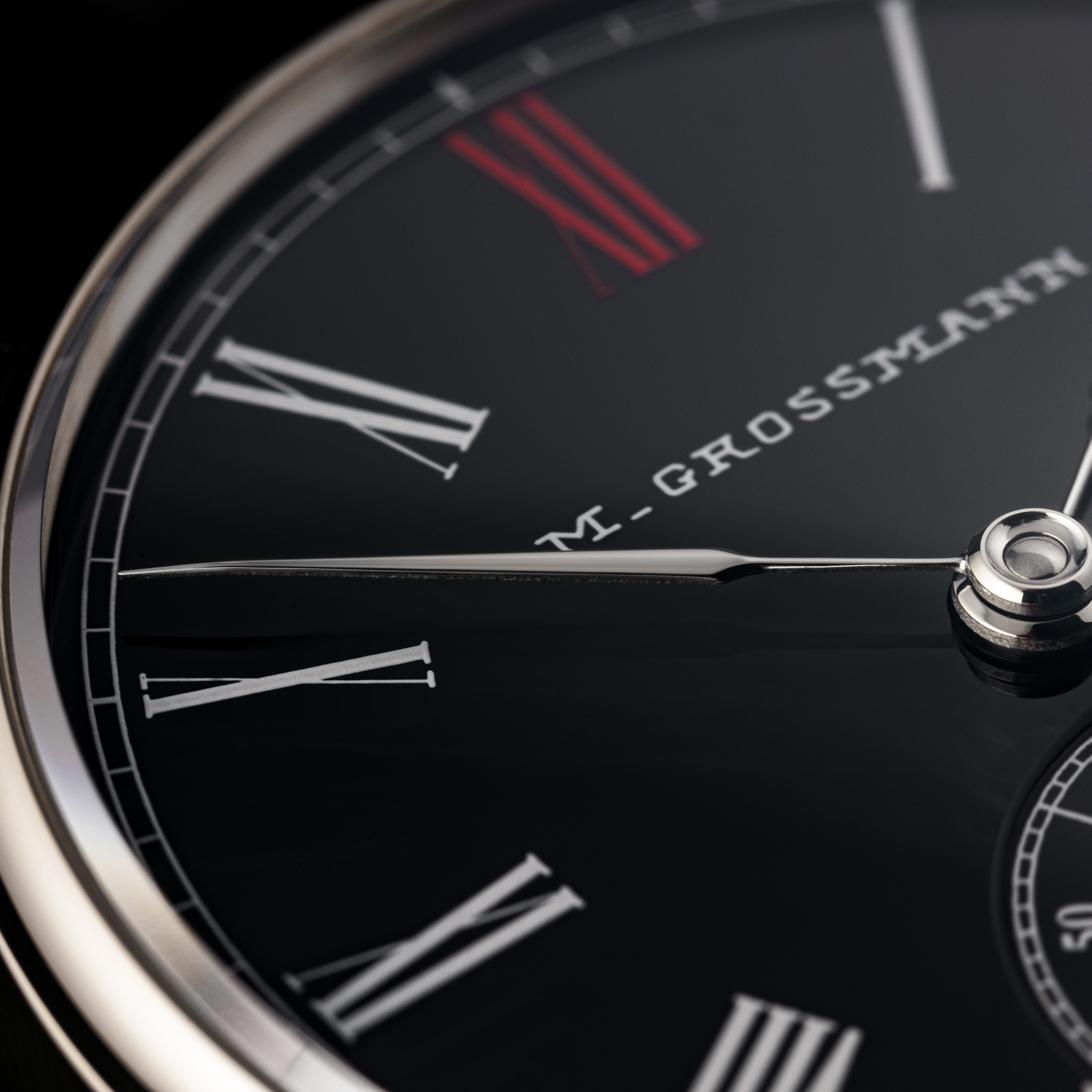
This is the tradition that gave rise to the enamel dial on the ENAMEL ROMAN Vintage by Moritz Grossmann. And this technique was not just used for the colour black, but the numerals, scales and lettering, such as the historic ‘M. Grossmann’ logo, are also made from enamel. These are applied using pad printing and then fired.

In all, around 90 steps are required to complete a single dial. These take several days to complete and at every single stage, there is a risk that the enamel will crack on firing, bubbles will form or the surface will flake. Only a dial that is perfect in every single way will eventually be used in a Moritz Grossmann watch. In such watches, it serves as the canvas for time, above which polished steel hands circle with their finely pointed tips.

The deep black of the dial is a reminder of the power of colour. The perfectly smooth surface is so still that you feel you could dive straight into it. This effect is underpinned by the slimline, finely drawn Roman numerals that contrast sharply with their clear white and the red XII. A simple case in white gold provides the perfect backdrop, with the sides merging seamlessly into the case horns. The transparent case back offers an unrestricted view of a movement that is perfection itself, matching the finish in every detail.
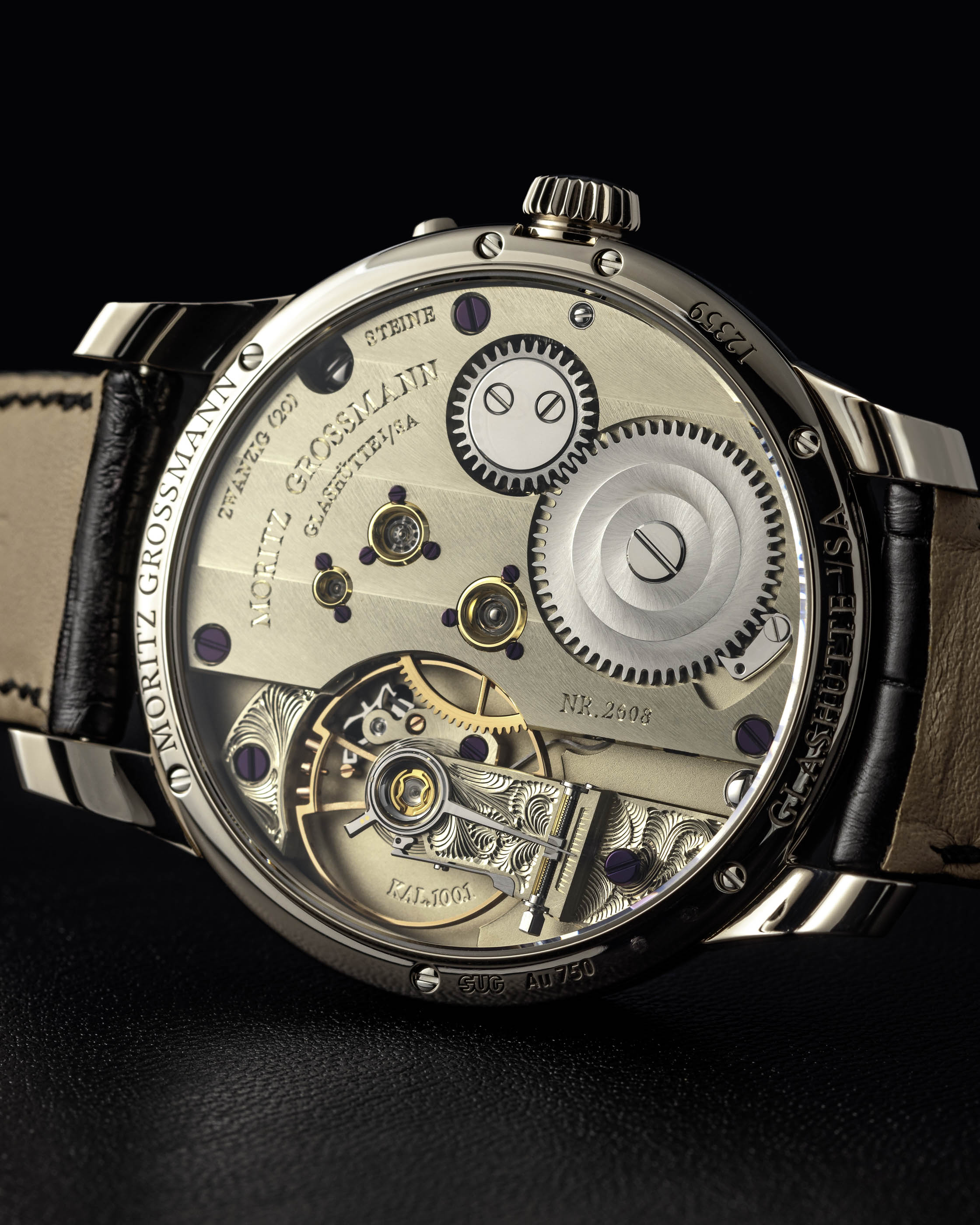
 

The art of watchmaking from Glashütte: the calibre 100.1
The inside of the ENAMEL ROMAN Vintage is home to the calibre 100.1, a pillar movement with well-proportioned components made from untreated German silver in a high-quality finish. The characteristic 2/3 plate with broad, horizontal ribbing has been signed by a hand engraving. It has a curved cut-out that reveals the distinctive Grossmann balance, held by a stepped, hand-engraved balance cock with the typical fine micrometer screw.

Another special feature of the manufactory movement is the perfected hand setting mechanism, which eliminates two potential problem areas: avoiding the ingress of foreign particles during the adjustment process and altering the hands unintentionally when pushing the crown back into place.

With a short pull on the winding crown, the mechanism switches to hand setting and stops the movement at the same time. The crown immediately returns to its original position, where the hands can now be precisely adjusted. The movement is then restarted using a pusher situated below the winding crown. This simultaneously resets the mechanism to its winding function.
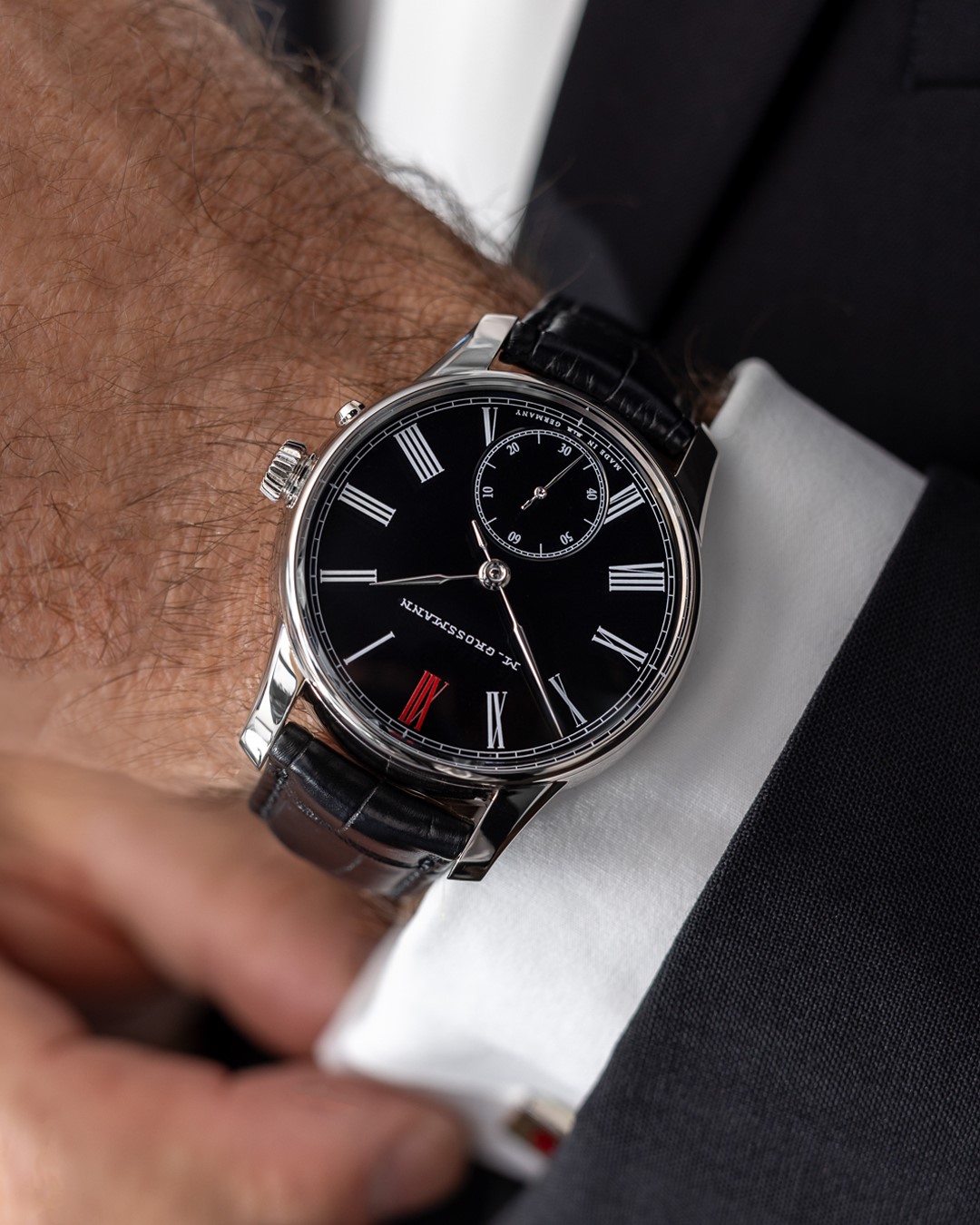
 

Exclusive special edition
The ENAMEL ROMAN Vintage in honour of the 16th anniversary of the manufactory has a case in white gold, worn on a black alligator leather strap. This special model is limited to eight pieces.
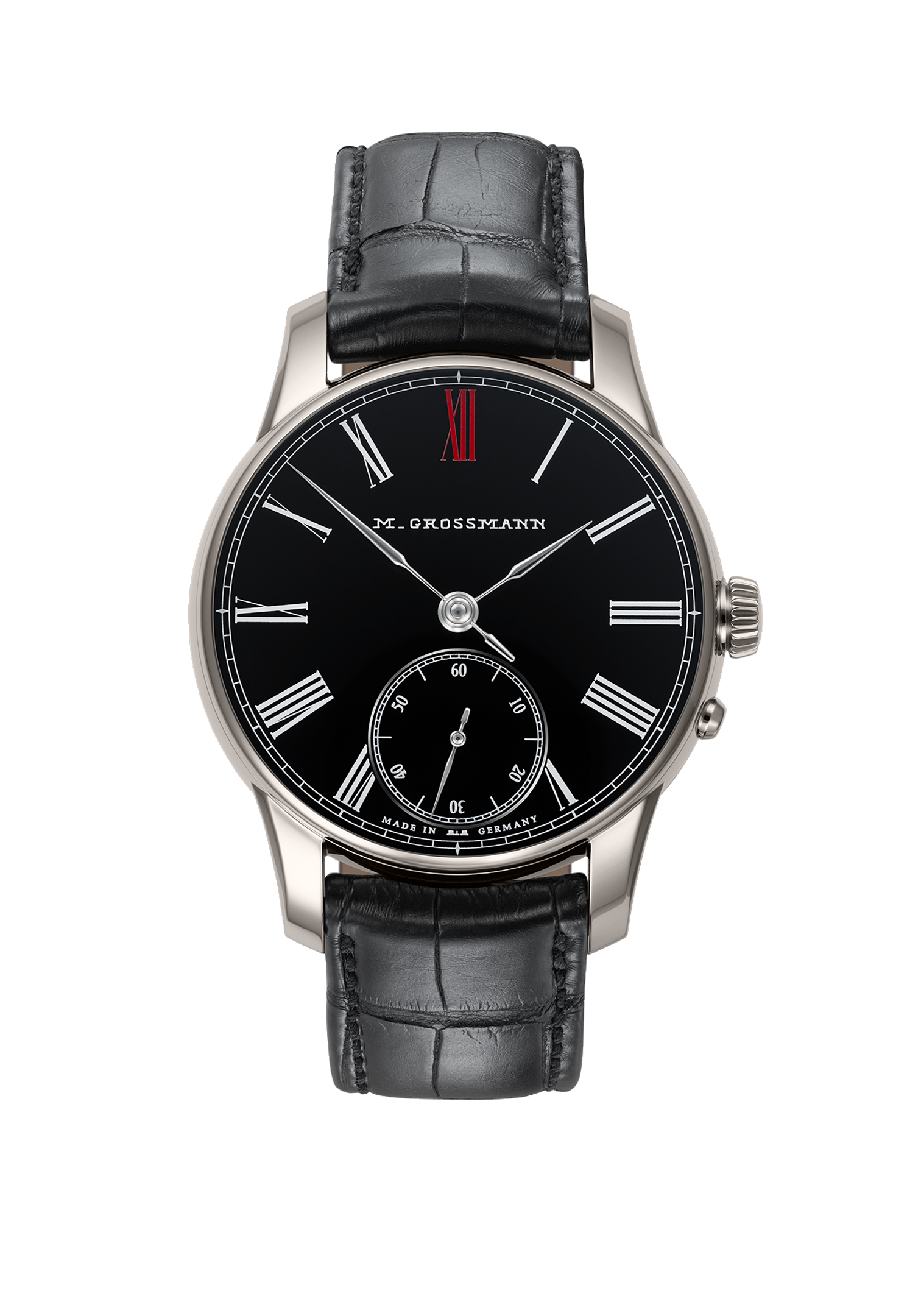
 

Enamel Roman Vintage

Technical Data


Version   Limited Edition of 8 pieces
Reference   MG-003717
     
Movement   Manufactory calibre 100.1, manual winding, regulated in five positions
No. of parts   198
Jewels   20 jewels, of which 3 in screwed gold chatons
Escapement   Lever escapement
Oscillator   Shock-resistant Grossmann balance with 4 inertia screws and 2 poising screws, Nivarox 1 balance spring with No. 80 Breguet terminal curve, Gustav Gerstenberger geometry
Balance Diameter   14.2 mm, frequency 18,000 semi-oscillations per hour
Power reserve   42 hours when fully wound
Functions   Hours and minutes, subsidiary seconds with stop second, Grossmann manual winder with pusher
Special features   Grossmann balance; hand setting override and start of movement with lateral pusher; space-saving modified Glashütte stopwork with backlash; adjustment with Grossmann micrometer screw on cantilevered balance cock; pillar movement with 2/3 plate and pillars made of untreated German silver; hand-engraved 2/3 plate, balance cock and escape-wheel cock hand-engraved; broad horizontal Glashütte ribbing; 3-band snailing on the ratchet wheel; raised gold chatons with pan-head screws; separately removable clutch winding mechanism; stop seconds for hand setting
Operating elements   Crown in 750/000 gold , to wind the watch and set the time, pusher in 750/000 gold to start the movement
Case dimensions   Diameter: 41.0 mm, height: 11.35 mm
Movement dimensions   Diameter: 36.4 mm, height: 5.0 mm
Case   Three-part, precious metal
Dial   Enamel, Roman numerals in white, XII in red
Hands   Manually crafted, polished steel
Crystal/display back   Sapphire crystal, antireflective coating on one side
Strap   Hand-stitched alligator leather with prong buckle in precious metal


Related Articles

JUNE 11 2026    |    Novelties

Angelus Instrument de Mesures: Triple Scale Monopusher Chronograph

Angelus unites the chronograph's key functional scales—telemeter, pulsometer, and tachymeter—in a single design. True to its heritage as a maker of functional timepieces, Angelus brings together the expertise developed through its previous instruments in the Instrument de Mesures. Produced in two limited editions of 25 pieces, this watch is a genuine instrument of measurement, designed to calculate elapsed time, the speed of sound, distance travelled and heart rate. Using a single chronograph hand, it integrates three functions, each with its own dedicated scale. Housed in a 39 mm steel case, its three-dimensional dial is both highly legible and meticulously graduated, giving the Instrument de Mesures the character of an authentic tool watch with a distinctive vintage charm and singular identity.

One Instrument, Multiple Measurements
Integrating these three scales alongside the essential minute track required a particularly sophisticated design approach. The amount of information to be displayed, combined with the need for legibility and clarity, led Angelus to adopt a distinct colour code for each function. This arrangement is reinforced by a three-dimensional dial construction, featuring a domed centre and outer edge connected by a sloping intermediate section. The telemetric scale is situated on the highest level at the periphery of the dial. The pulsometer extends across the angled intermediate section, and the tachymeter, in the form of a spiral, is located closest to the hands.

The In-House A5000 Chronograph Calibre
The Instrument de Mesures is powered by Angelus's in-house A5000 chronograph calibre. Its classical architecture showcases numerous intricately shaped components, providing an ideal canvas for high-end finishing. Faithful to the great traditions of chronograph watchmaking, the A5000 incorporates a column wheel and a horizontal clutch, both defining features of traditional chronographs.


View Watch Gallery
Angelus Instrument de Mesures

Angelus Instrument de Mesures

Angelus Instrument de Mesures

Angelus Instrument de Mesures
View More
APRIL 29 2026    |    Novelties

A Splash of Fresh Green: Moritz Grossmann Debuts the TEFNUT Silver-Plated by Friction Anniversary Watch

The year 2026 marks a historic milestone for the Moritz Grossmann manufactory in Glashütte, as it celebrates the 200th birthday of its visionary founder and namesake, born on March 27, 1826. A genius watchmaker, scientist, author, and initiator of the German Watchmaking School, Grossmann profoundly shaped the craft of horology and the fate of his hometown. Rather than merely imitating historical concepts, the modern manufactory honors his legacy by blending his cutting-edge philosophy with modern engineering. This dedication to technological perfection and exceptional aesthetics cements its place among the world's elite elite watchmakers.

To commemorate this bicentennial occasion, the brand has unveiled its third anniversary special edition: the TEFNUT Silver-Plated by Friction. Debuting on April 29, 2026, this launch presents an exclusive premiere for collectors—the very first time that the sleek TEFNUT model is made available in a stunning 750/000 yellow gold case, alongside a 750/000 white gold version. Both variations pay homage to their heritage by incorporating an "1826" engraving on the balance cock and showcasing a vintage 1875 "M. GROSSMANN" logo on the dial.

At the heart of the timepiece lies the ultra-flat manufactory calibre 102.1, a hand-wound movement measuring just 4 mm in height and 26 mm in diameter. This compact footprint enables the watch to retain its remarkably elegant, low-profile silhouette. The calibre embodies classic Grossmann pillar movement architecture with a 3/5 plate, incorporating his signature raised gold chatons, an optimized mainspring barrel with bilateral jewel bearings, and a stepped balance cock with a micrometer screw. Each component is meticulously hand-finished to ensure absolute technical and visual distinctiveness.

The defining aesthetic feature of this model is its striking dial, which boasts a rare "silver-plated by friction" finish. Executed entirely by hand in the brand's ateliers, a master artisan brushes a specialized paste of silver powder, salt, cream of tartar, and water onto the brass surface to create a velvety, fine-grained texture that beautifully diffuses light. To provide a contemporary contrast, the numerals, minute scale, and historic logo are rendered in a vibrant green hue. Hovering above are extraordinarily fine, hand-crafted lance-shaped hands, polished in gold for the yellow gold model and annealed to a brown-violet tone for the white gold edition. Each variation is strictly limited to just 12 pieces worldwide.

View Watch Gallery  
Image 1  Image 2 Image 3  Image 4       
View More
AUGUST 26 2025    |    Novelties

Armin Strom Unveils Tribute 1 Sandstein: A Timeless Homage Cast in Sandstone

Drawing inspiration from the natural beauty and architectural heritage of Burgdorf, Armin Strom introduces the Tribute 1 Sandstein, a limited edition timepiece that blends Swiss tradition with modern refinement. With only 50 pieces available globally, this elegant watch pays tribute to the region’s iconic sandstone and the brand’s artisanal roots.

Encased in a 38 mm stainless steel case with alternating brushed and polished finishes, the Tribute 1 Sandstein features a warm sand-toned off-centre dial adorned with a grain d’orge guilloché pattern and Roman numerals. A frosted subdial and matching sand Alcantara strap complete the harmonious design.

At its heart beats the in-house Caliber AMW21, a hand-wound movement offering an impressive 100-hour power reserve. The visible motor barrel, held by a mirror-polished finger bridge, adds a modern technical flair while honoring traditional Swiss watchmaking values.

Through sapphire crystals on both sides, the movement reveals Armin Strom’s signature hand-finishing: hand-bevelled bridges, black-polished screws, Geneva stripes, and circular graining. Each watch is assembled twice, ensuring mechanical precision and aesthetic integrity.  

View Watch Gallery
Image 1 Image 2  
View More
JUNE 25 2024    |    Novelties

Back in sleek anthracite: Armin Strom unveils the One Week Manufacture Edition

Biel/Bienne, Switzerland, 26 June 2024: Following the inaugural redesigned One Week First Edition that made its debut in 2023, Armin Strom unveils a new version of the successor to its first-ever manufacture movement with the One Week Manufacture Edition. The highly architectural openworked movement, housed in a sleek and sporty steel case with an integrated bracelet, is now presented in a range of grey and anthracite hues. Limited to 100 pieces, the One Week Manufacture Edition foregoes colour to bring out the beauty of its uniquely constructed manual calibre.

15 years ago, independent watchmaking brand Armin Strom took a major leap that would forever change its trajectory. Realising that the path to true independence lies in mastering every step of the process, it established its very own manufacture in Biel. A year later, the first timepiece produced by its vertically integrated manufacture was unveiled: the One Week. Entirely developed and manufactured in-house and designed with symmetrical harmony in mind, it stood out thanks to its unique movement architecture featuring two barrels that together provide a seven-day power reserve. This milestone marked the beginning of many new calibres and innovations by the Armin Strom manufacture, showcasing their dedication to the science of movement and garnering the admiration and respect of even the most discerning and seasoned collectors.

The new One Week Manufacture Edition completely reimagines this milestone calibre in line with the brand’s recent bolder, more three-dimensional approach to calibre design, all in a sleek and serene execution that further highlights its ingenuity and uniqueness. The mainplate, bridges and parts, visible on the dial thanks to the openworked movement design, are anthracite PVD coated for a striking look.

As Armin Strom founder Serge Michel notes: “Collectors who missed the opportunity to get a first edition of the redesigned One Week will now have another chance. The Manufacture Edition of the new One Week will be limited to 100 pieces.”

Sporty yet classy, this model exudes calmness and serenity with its anthracite tones and the symmetrical harmony of its in-house movement.

View More
APRIL 08 2026    |    Watches and Wonders 2026

Tinkler 1958: Precision at a Quarter Turn

A faithful tribute to the original model, the Tinkler 1958 repeater celebrates Angelus’s rich heritage of striking watches. Driven by a self-winding quarter-repeater movement, this double limited edition, available in gold or steel, continues the tradition of measuring instruments that built the manufacture’s reputation. From its establishment in 1891, the name Angelus has been synonymous with the chiming of a bell, a legacy reinforced by one of the Maison's first patents for a silent strike governor in 1896. Since then, repeater mechanisms have remained at the heart of Angelus collections, even being adapted into Braille-repeating watches for blinded soldiers during the First World War.

Inspired by this glorious history, Angelus is reissuing one of its rarest and most refined models: the Tinkler, based on the original 1958 edition. In 1958, Angelus filed a patent for a striking wristwatch, which was immediately followed by the original Tinkler—a pioneer of water-resistant, self-winding quarter-repeater watches. The new 38-mm case charms with a decidedly 1950s aesthetic that is clean, understated, and elegant. At 9 o’clock, the crown is balanced by a pusher that activates the quarter repeater, serving as a functional and historical hallmark of this legendary model.

The Tinkler 1958 edition is driven by the new Angelus A600 calibre, a mechanical self-winding movement that beats at 4Hz and offers a 70-hour power reserve. On request, the pusher at 9 o’clock triggers a sequence where each hour is marked by a clear strike on the first gong, followed by a double strike on two gongs to signal each quarter hour. The movement's finishing demonstrates the watchmaker's extreme attention to detail, featuring a snail-finished main plate, palladium-plated bridges adorned with Côtes de Genève, and a tungsten sunburst oscillating weight.

This new release is part of the La Fabrique line, where Angelus continues its legacy as a maker of specialty watches designed for specific activities or professional uses. The Tinkler 1958 is limited to 15 pieces in 18-carat yellow gold and 25 pieces in stainless steel, each paired with an alligator flank leather strap—ink blue for the gold version and saddle brown for the steel. Combining a modernist-style numeral 12 with exclamation-shaped hour markers at the quarter positions, the watch serves as a modern embodiment of a daring yet functional tradition.

View Watch Gallery  
Image 1  Image 2 Image 3  Image 4       
View More
ENDLESS DISCOVERY IN YOUR INBOX
Join our mailing list to receive insider updates on our latest collections, invites to private events, and other personalized offerings.